Recent phosphoric acid market volatility has created new cost pressure across several downstream industries. For manufacturers and buyers of wood-based powdered activated carbon, this is especially relevant because phosphoric acid is a key activating agent used in the production of many wood-based activated carbon grades.
As raw-material prices rise, the impact is not limited to phosphoric acid itself. It can also affect production planning, quotation validity, supply stability, and purchasing decisions for activated carbon used in decolorization and purification processes.
Why Phosphoric Acid Matters in Wood-Based Powdered Activated Carbon Production
Wood-based powdered activated carbon is widely used in liquid-phase purification applications, including sugar refining, citric acid purification, food processing, pharmaceutical processing, chemical decolorization, and wastewater treatment.
For phosphoric-acid-activated wood carbon, phosphoric acid plays an important role during the activation process. It helps develop the internal pore structure of the carbon and supports adsorption performance in liquid applications.
This production route is commonly selected for products requiring strong decolorization performance, fine particle size, and stable filtration behavior.
Why Phosphoric Acid Prices Are Rising
Recent phosphoric acid price increases are closely related to higher upstream costs and supply-chain pressure. Changes in phosphate-related raw materials, sulfur, energy, transportation, and market supply can all influence the final cost of phosphoric acid.
As phosphoric acid is an important chemical input in wood-based activated carbon production, these market changes can gradually be transmitted to activated carbon manufacturers and downstream buyers.
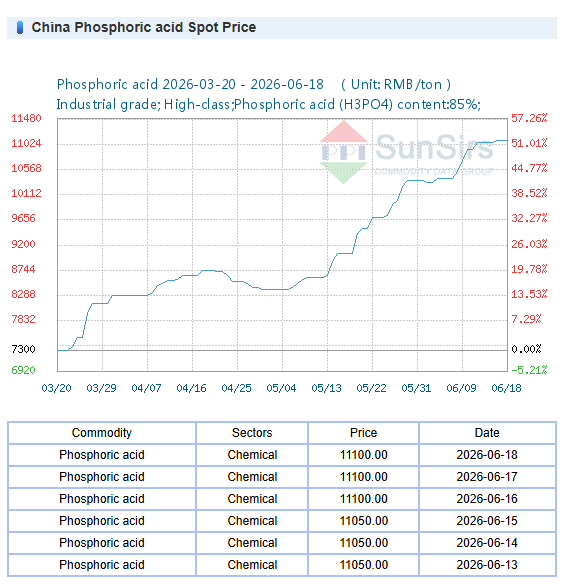
cr. SunSirs: Rising Costs Drove Up Market Prices for Phosphoric Acid
How Higher Phosphoric Acid Costs Affect Wood Powder Carbon
1. Production Costs Increase
Phosphoric acid is not a minor auxiliary material in this production process. It is an important chemical input used during activation, so a sharp increase in phosphoric acid prices can directly raise the manufacturing cost of wood-based powdered activated carbon.
For products with higher adsorption requirements or more demanding decolorization applications, maintaining stable quality may require continued investment in raw materials and process control.
2. New Order Prices May Need Adjustment
When phosphoric acid prices change rapidly, historical activated carbon quotations may no longer reflect current production costs. New orders may therefore require updated pricing based on the latest raw-material situation.
This is particularly relevant for customized grades with requirements for mesh size, methylene blue value, ash content, moisture, pH value, filtration performance, or application-specific decolorization efficiency.
3. Quotation Validity May Become Shorter
During a stable market period, suppliers can usually maintain quotations for a longer time. However, when key chemical raw materials fluctuate significantly, quotation validity may need to be shortened to reduce uncertainty for both suppliers and buyers.
For regular purchasing programs, it is advisable to reconfirm pricing and production schedules before placing a new order.
Applications Most Likely to Be Affected
The impact of rising phosphoric acid prices may be more visible in wood-based powdered activated carbon used for the following applications:
- Sugar and sweetener decolorization
- Citric acid purification
- Food and beverage processing
- Edible oil refining
- Pharmaceutical and nutraceutical processing
- Fine chemical purification
- Industrial wastewater treatment
- Liquid-phase odor and color removal
In these applications, activated carbon is often evaluated not only by unit price, but also by adsorption performance, dosage, filtration speed, and batch-to-batch consistency.
Why Performance Stability Is More Important During a Rising Cost Cycle
When raw-material prices increase, choosing activated carbon based only on the lowest unit price can create additional risks. A lower-cost product may require a higher dosage, cause slower filtration, or lead to inconsistent decolorization results.
For many liquid purification processes, the more practical comparison is total treatment cost rather than product price per kilogram. A stable wood-based powdered activated carbon with suitable pore structure and reliable adsorption performance can help improve processing efficiency and reduce unnecessary consumption.
Practical Purchasing Suggestions for Buyers
To reduce the impact of market volatility, buyers may consider the following points when sourcing wood-based powdered activated carbon:
- Confirm application requirements before requesting a quotation.
- Provide clear specifications for mesh size, methylene blue value, ash, moisture, pH, and required performance.
- Confirm quotation validity before arranging purchase orders.
- Consider forecast orders for regularly used grades.
- Evaluate activated carbon based on dosage and treatment performance, not only unit price.
- Communicate early with suppliers regarding production lead time and raw-material changes.
HANYAN Support for Wood-Based Powdered Activated Carbon
At HANYAN Activated Carbon, we continue to monitor key raw-material market changes and arrange production based on confirmed customer requirements.
For wood-based powdered activated carbon used in decolorization and purification, we can support customers with product selection, specification confirmation, sample evaluation, and supply planning based on different process requirements.
Early communication is recommended for customers with regular demand, customized specifications, or upcoming purchasing plans, especially during periods of significant phosphoric acid market fluctuation.
Conclusion
Rising phosphoric acid prices are an important market factor for wood-based powdered activated carbon. Since phosphoric acid is closely linked to the activation process, changes in its price can influence production cost, quotation stability, and supply planning.
For buyers, the best response is to confirm technical requirements early, maintain close communication with suppliers, and focus on stable adsorption performance and total treatment cost. This approach can help reduce purchasing uncertainty while supporting more reliable downstream production.
Article Keywords: phosphoric acid price, wood-based powdered activated carbon, phosphoric acid activated carbon, wood powder activated carbon, activated carbon price trend, decolorization activated carbon, citric acid decolorization carbon, liquid purification activated carbon