When a buyer requests the iron, lead, cadmium or other trace-element content of activated carbon, it may seem that the answer depends mainly on the instrument. Inductively coupled plasma (ICP) analysis can measure multiple elements in a prepared solution. Yet the number in the final report also depends on how the carbon was sampled, prepared and interpreted.
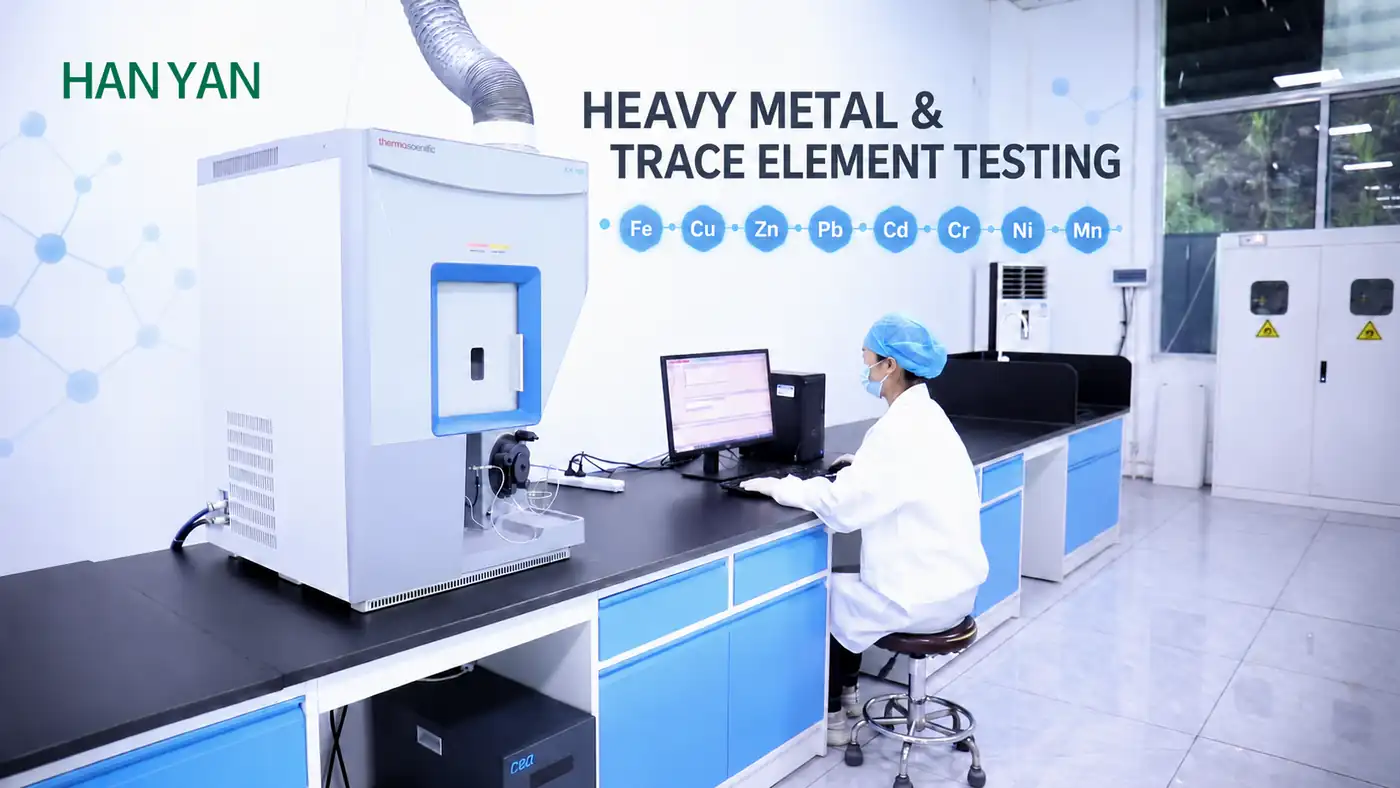
At HANYAN, in-house ICP testing supports our assessment of elemental content in activated carbon and comparison with customer samples. A useful report requires more than an instrument reading: the test objective, sample preparation and reporting basis must match what the customer actually needs. This guide explains why pretreatment matters, what can shift the result and how to compare data from different laboratories.
Contents
- First define what the test should measure
- Why sample pretreatment is critical
- Factors that can change ICP results
- How laboratories check data quality
- How to compare results and specifications
- How HANYAN uses ICP testing
1. First Define What the Test Should Measure
“Heavy metals in activated carbon” is not a complete test request. Before selecting a procedure, the laboratory needs to know which elements matter and whether the customer wants their total content in the solid, the amount released under a particular extraction condition, or the concentration in treated water after the carbon has been used.
| Test objective | What the result describes | Typical reporting basis |
|---|---|---|
| Elemental content of the carbon | Elements recovered from the solid using the specified digestion procedure | mg/kg of carbon, with the moisture basis stated |
| Acid-extractable or water-leachable elements | Elements released under a specified liquid, time, temperature and solid-to-liquid ratio | mg/L in the extract or mg/kg of carbon, as the method defines |
| Water-treatment performance | Change in a target element’s concentration after contact with the carbon | Inlet and outlet concentrations under stated test conditions |
These tests answer different questions. A low concentration in a water extract does not prove that the total elemental content of the carbon is equally low. Likewise, measuring the carbon itself does not establish how efficiently it removes dissolved metals from water. That requires a separate adsorption test with defined water chemistry, contact time, dosage or bed conditions.
2. Why Sample Pretreatment Is Critical
ICP instruments analyze a liquid sample. To assess elements in solid activated carbon, the laboratory must first obtain a representative portion and bring the target elements into an appropriate solution. The preparation step determines which fraction of the sample is available for measurement.
Sampling and homogenization
Activated carbon may be supplied as powder, granules, pellets or structured blocks. Trace elements can be distributed unevenly among particles or batches. A small scoop from the top of one bag may not represent a full shipment. The sampling plan, particle preparation and subsample size should be suitable for the material and the purpose of the test. Grinding or mixing may improve consistency, but tools and containers must be clean enough to avoid introducing the very elements being measured.
Digestion and extraction are different
An acid digestion aims to transfer specified elements from the solid into a solution for analysis. Its effectiveness depends on the reagents and conditions used, as well as the carbon’s mineral content and the elements of interest. Some digestion procedures measure an operationally defined recoverable fraction; they should not automatically be described as a complete or absolute total digestion. More intensive methods may be required when the objective is to include elements bound in difficult-to-dissolve mineral phases.
In contrast, an extraction or leaching test intentionally measures what comes out under a defined set of conditions. Acid type or pH, liquid-to-solid ratio, contact time and temperature may all change the result. The chosen extraction must therefore reflect the customer’s specification or intended application.
For these reasons, simply saying “tested by ICP” is insufficient. ICP identifies the measurement technique; the sample preparation and test conditions define what was actually measured.
3. Factors That Can Change the Result
Differences between laboratories do not necessarily mean that one instrument is wrong. Review the complete process when two numbers disagree:
- Sample representativeness: Were both laboratories given material from the same batch and a comparable, well-mixed subsample?
- Preparation route: Was each sample digested, acid-extracted or water-leached? Were the reagents and conditions equivalent?
- Contamination: Could sampling tools, grinding equipment, vessels, reagents or laboratory water have introduced trace elements?
- Incomplete recovery or loss: Did the preparation release the target elements effectively and keep them in solution until analysis?
- Matrix interference: Did dissolved salts, residual carbon-derived material or spectral overlap affect the instrument reading?
- Dilution and detection limits: Was the digest diluted, and is the method sufficiently sensitive for the contractual limit?
- Moisture and units: Was the result calculated on an as-received or dry-weight basis, and was it reported in mg/kg or mg/L?
For a solid sample, the measured concentration in the final solution must be converted using the prepared solution volume, dilution factor and sample mass. A calculation or moisture-basis difference can create a discrepancy even when the instrument readings are similar.
4. How Laboratories Check Data Quality
A robust internal method defines not only the preparation steps but also the checks used to decide whether a result is reliable. Depending on the method and analyte, these may include a preparation blank, calibration checks, replicate samples, a known reference material, a laboratory control sample and spike recovery tests. A blank can reveal contamination, while duplicates and recovery checks help evaluate precision and possible matrix effects.
Quality-control criteria should fit the chosen method and required concentration range. An instrument’s theoretical detection capability is not the same as the reporting limit achieved after a real carbon sample has been digested and diluted. For a result reported as “not detected,” the reporting limit must be low enough to answer the customer’s specification.
Many manufacturers develop internal procedures suited to their products and routine quality control. These procedures can be valuable for monitoring batch consistency. If the customer requires a named standard method, a particular accreditation scope or a third-party report, that requirement should be agreed before testing; an internal method should not be presented as an identical substitute without method comparison or validation.
5. How to Compare ICP Reports and Customer Specifications
When benchmarking a new carbon against a customer’s reference sample, first compare the test definition rather than the figures alone. The checklist below helps prevent a misleading like-for-like comparison:
| Item to confirm | Question to ask |
|---|---|
| Target elements | Are both reports measuring the same element and, where relevant, the same chemical species? |
| Test object | Is the result for unused carbon, an extract, treated water or spent carbon? |
| Preparation method | Are the digestion or extraction reagents, conditions and measurement scope comparable? |
| Sample basis | Are the samples from comparable lots and reported on the same dry or as-received basis? |
| Units and limits | Are units, reporting limits and any “less than” values interpreted correctly? |
| Acceptance criteria | Is the customer’s limit based on a particular method, application or regulatory requirement? |
For example, a result reported as <1 mg/kg does not mean zero; it means the analyte was below that report’s stated reporting limit. It also cannot demonstrate compliance with a specification of <0.5 mg/kg. Similarly, a low acid-extractable iron value should not be directly compared with a total iron result unless the methods have been shown to be comparable for that material.
If results disagree, retain representative samples from the same lot and align the preparation method, reporting basis and laboratory quality checks before retesting. This is usually more productive than comparing isolated numbers from reports prepared for different purposes.
6. How HANYAN Uses ICP Testing
HANYAN’s in-house ICP instrument helps our team examine trace-element content, monitor product consistency and compare customer-provided samples with candidate activated carbon grades. We can discuss the elements and test objective that matter to the project, then review results in the context of the agreed sample preparation and reporting method.
For applications with special purity requirements, the test plan should be confirmed before a product is approved. If an external laboratory, specific standard or accreditation is required, that requirement can be incorporated into the evaluation. The goal is to provide data that answers the customer’s actual question—not just a list of numbers from the instrument.
Conclusion
ICP analysis is a useful tool for measuring trace elements in activated carbon, but the result begins with a defined test objective and suitable sample preparation. Sampling, digestion or extraction, quality controls and reporting basis can each influence the number a buyer sees. When comparing products, make sure both reports measure the same thing under comparable conditions.
Article Keywords: ICP testing activated carbon, trace elements in activated carbon, heavy metals in activated carbon, activated carbon sample preparation, ICP analysis of activated carbon, acid-extractable metals, activated carbon quality control