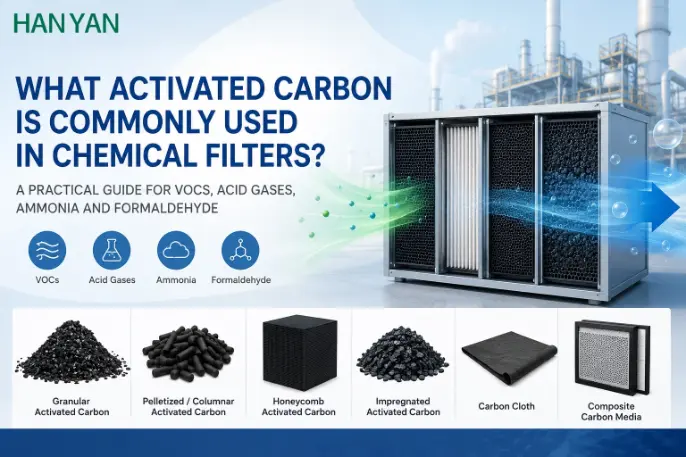
Chemical filters are widely used in air purification, HVAC systems, industrial exhaust treatment, cleanrooms, laboratories, protective equipment, and odor-control systems. Unlike particle filters, which mainly remove dust and aerosols, chemical filters are designed to capture gaseous pollutants.
Activated carbon is one of the most commonly used materials in chemical filters because of its developed pore structure and strong adsorption ability. However, not every gas can be treated effectively with the same carbon. The right choice depends on the target contaminant, airflow, humidity, filter structure, and expected service life.
Chemical Filters Are Not the Same as Dust Filters
A common misunderstanding is that a high-efficiency particle filter can solve all air-quality problems. In fact, HEPA or other particle filters mainly capture solid particles and aerosols. They are not designed to remove most gaseous molecules such as VOCs, ammonia, hydrogen sulfide, or formaldehyde.
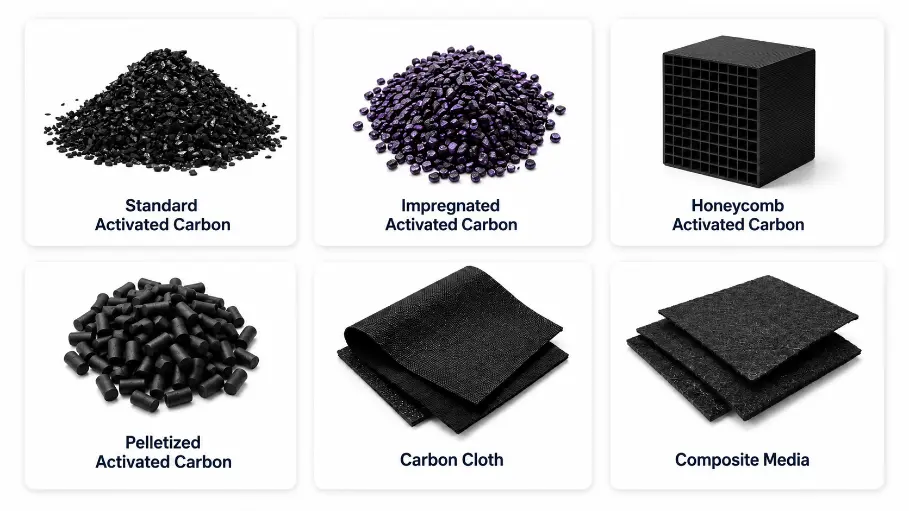
For gas-phase pollutants, chemical filtration media are needed. These may include granular activated carbon, pellet activated carbon, honeycomb activated carbon, impregnated activated carbon, carbon cloth, or composite filter media.
1. Standard Activated Carbon for VOCs and General Odors
Standard activated carbon is commonly used for volatile organic compounds, solvent vapors, and general odors. Typical target gases may include toluene, xylene, benzene-related vapors, esters, ketones, alcohols, and other organic compounds.
Depending on the filter design, the carbon may be used in different forms:
- Granular activated carbon for packed-bed filters
- Pelletized activated carbon for lower dust and stable airflow
- Honeycomb activated carbon for high-airflow and low-pressure-drop systems
- Carbon cloth or composite media for thin filter structures
For general VOC adsorption, the key selection factors include adsorption capacity, pore structure, particle size, dust level, pressure drop, and carbon loading inside the filter.
2. Impregnated Activated Carbon for Specific Gases
Some gases are not efficiently removed by standard activated carbon alone. For gases such as ammonia, hydrogen sulfide, sulfur dioxide, acidic gases, alkaline gases, and formaldehyde, impregnated activated carbon is often considered.
Impregnated activated carbon is produced by adding selected chemical agents to the activated carbon. These agents can improve removal performance for specific gases through targeted adsorption or chemical reaction.
For example:
- Acid-treated carbon may be used for alkaline gases such as ammonia.
- Alkaline or specially treated carbon may be used for acidic gases.
- Special formulations may be selected for formaldehyde, sulfur compounds, or mixed odors.
- ABEK-type carbon is commonly used when multiple gas groups need to be considered in protective or safety-related applications.
However, impregnated carbon is not a universal solution. The impregnation chemistry should match the target gas. Using the wrong treated carbon may increase cost without improving performance.
3. Honeycomb Activated Carbon for High-Airflow Chemical Filtration
Honeycomb activated carbon is often used when the system requires lower pressure drop and stable airflow. Its straight-through channels allow air to pass through the carbon block more easily than many dense packed-bed structures.
This makes honeycomb carbon suitable for applications such as:
- Industrial VOC treatment
- Spray booth exhaust
- Printing exhaust gas treatment
- Odor-control equipment
- Air-handling units with limited pressure-drop allowance
For honeycomb chemical filters, buyers should confirm block size, thickness, CPSI, carbon loading, adsorption grade, and installation direction. If the target gas includes ammonia, hydrogen sulfide, or acidic gases, a special treated grade may be required.
4. Granular or Pellet Activated Carbon for Longer Service Life
Granular or pelletized activated carbon is commonly used in filters where higher carbon loading and longer service life are required. Packed-bed filters, V-bank filters, refillable cartridges, and deep-bed chemical filters often use this type of carbon.
Compared with thin filter media, a deeper carbon bed can provide longer gas contact time and higher adsorption capacity. However, it may also create higher pressure drop if the particle size, bed depth, and airflow are not designed properly.
For industrial chemical filters, pelletized coal-based carbon or coconut shell carbon may be selected depending on the target gases, required hardness, dust control, and adsorption performance.
5. Carbon Cloth and Composite Media for Compact Filters
In some air purifiers, HVAC panels, masks, and compact chemical filters, carbon cloth or composite media may be used instead of loose granular carbon. These materials are useful where space is limited and a thin, lightweight filter structure is needed.
However, thin media usually contains less total carbon than a deep-bed filter. Therefore, it may be suitable for light-duty odor control or short contact-time applications, but not always for high-concentration industrial gas treatment.
How to Choose the Right Carbon for a Chemical Filter
Before selecting activated carbon for a chemical filter, buyers should first identify the target gas. Choosing by carbon type alone is not enough.
Useful information includes:
- Target pollutants, such as VOCs, NH3, H2S, SO2, HCl, formaldehyde, or mixed odors
- Gas concentration and airflow volume
- Operating temperature and humidity
- Required pressure drop
- Available filter size and carbon loading
- Expected service life or replacement cycle
- Whether the filter is used for HVAC, industrial exhaust, cleanroom, protective, or odor-control applications
With this information, the supplier can recommend whether standard activated carbon, impregnated activated carbon, honeycomb carbon, pelletized carbon, or composite media is more suitable.
HANYAN Support for Chemical Filter Applications
HANYAN provides different activated carbon materials for chemical filtration, air purification, VOC treatment, odor control, and protective applications. Depending on the target gas and filter structure, we can support customers with granular carbon, pelletized carbon, honeycomb activated carbon, impregnated carbon, and carbon media solutions.
If you are developing or replacing a chemical filter, please share your target gases, airflow, filter size, working environment, and expected service life. This information helps us recommend a more suitable activated carbon grade for your application.
Conclusion
The best activated carbon for a chemical filter depends on what the filter needs to remove. Standard activated carbon is widely used for VOCs and general odors, while impregnated activated carbon is often needed for ammonia, acid gases, hydrogen sulfide, formaldehyde, or other specific gases.
Filter structure also matters. Honeycomb carbon is useful for high-airflow and low-pressure-drop systems, granular or pelletized carbon is suitable for higher carbon loading, and composite media can be used in compact filter designs.
By matching the carbon type, target gas, airflow, humidity, and filter design, buyers can build a more effective and reliable chemical filtration solution.
Article Keywords: activated carbon for chemical filter, chemical filter activated carbon, impregnated activated carbon, activated carbon for VOC removal, activated carbon for ammonia removal, activated carbon for acid gas removal, activated carbon for formaldehyde removal