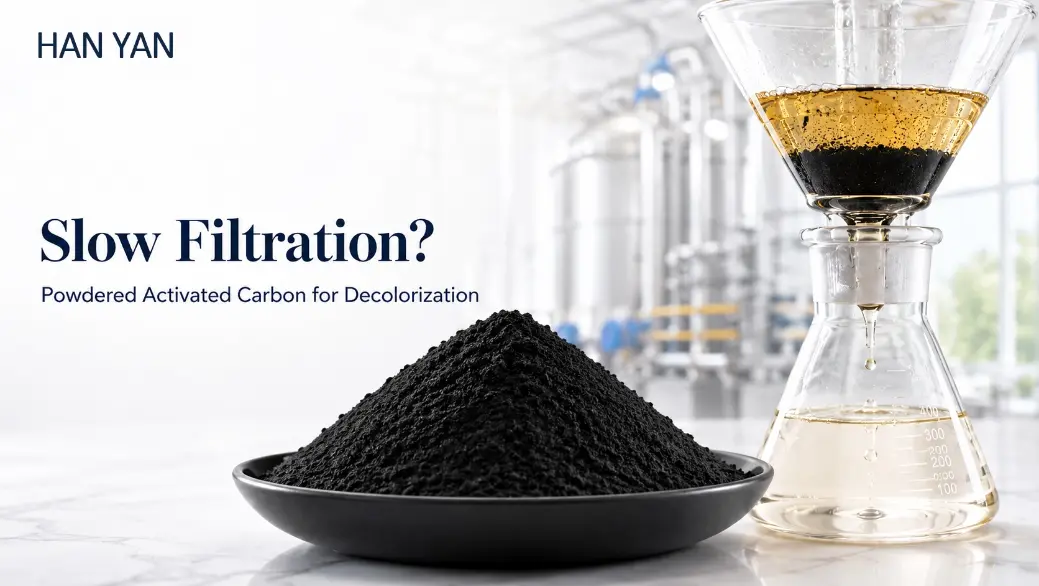
Powdered activated carbon is widely used in liquid decolorization and purification processes. It can help remove unwanted color, odor, trace impurities, and certain organic compounds from sugar solutions, organic acids, food ingredients, pharmaceutical intermediates, and fine chemicals.
However, some users encounter a practical problem after carbon treatment: the decolorization result may be acceptable, but filtration becomes slow. In some cases, the filter cake becomes dense, filtration pressure rises quickly, or the production cycle takes longer than expected.
Slow filtration is not always caused by the activated carbon alone. It is usually the result of several factors working together, including carbon particle size distribution, fine powder content, carbon dosage, liquid viscosity, suspended solids, process temperature, and filtration equipment conditions.
Why Filtration Matters After Activated Carbon Decolorization
In a typical decolorization process, powdered activated carbon is added into the liquid, mixed for a certain contact time, and then removed by filtration. The activated carbon carries adsorbed color bodies and impurities, forming a filter cake on the filter medium.
If this filter cake is too compact or difficult to build, the filtration rate may decrease. This can lead to longer processing time, lower production efficiency, higher filtration pressure, and greater use of filter aids or cleaning resources.
For this reason, effective decolorization should not be evaluated only by color removal. A suitable activated carbon should also support stable filtration performance under the customer’s actual operating conditions.
Common Reasons Why Powdered Activated Carbon Causes Slow Filtration
1. Excessive Fine Powder Content
Fine particles can provide fast contact with the liquid and may support adsorption in some applications. However, when the proportion of very fine powder is too high, the particles can fill the gaps within the filter cake.
This creates a denser cake structure and reduces liquid flow through the filter. As a result, filtration may become slower even when the carbon has good decolorization performance.
For this reason, buyers should not only ask for a general mesh size, such as 200 mesh or 325 mesh. It is also important to understand the particle size distribution and the proportion of ultrafine particles.
HANYAN has the state-of-the-art pore size analyzer to provide the particle size distribution report for reference.
2. A Broad or Unstable Particle Size Distribution
Two powdered activated carbon products may both be described as the same mesh size, but their actual particle size distributions can be very different.
A product containing a wide range of particle sizes may form an uneven filter cake. Larger particles can create initial cake structure, while very fine particles may migrate into the gaps and reduce permeability. This can make filtration less stable from batch to batch.
A more controlled particle size distribution can help create a more consistent filter cake and improve process repeatability.
3. Carbon Dosage Is Higher Than Necessary
When color removal is difficult, some users increase the activated carbon dosage in order to achieve a better result. While this may improve decolorization, it also increases the total solid load that must be removed by filtration.
Higher dosage means a thicker filter cake, more carbon retained in the filtration system, and potentially slower flow. In some cases, the dosage is increased because the selected carbon is not well matched to the impurity profile of the liquid.
Instead of increasing dosage immediately, it is often better to evaluate whether a different pore structure, raw material source, or adsorption grade may achieve the same result more efficiently.
4. The Liquid Itself Has High Viscosity or High Suspended Solids
Slow filtration can also be related to the treated liquid rather than the activated carbon. High-viscosity solutions, syrups, concentrated acids, oils, or liquids containing suspended solids can naturally filter more slowly.
When activated carbon is added to a system that already contains fine solids or colloidal impurities, the resulting filter cake can become more compact. This may be especially noticeable in sugar solutions, food ingredients, fermentation liquids, and certain chemical intermediates.
In these cases, the carbon selection should be evaluated together with the full liquid system, not in isolation.
5. Inadequate Mixing or Contact Conditions
Mixing conditions can affect both adsorption efficiency and later filtration behavior. If the activated carbon is not dispersed evenly, localized agglomeration may occur. This can reduce effective contact between the carbon and the liquid while creating irregular solids during filtration.
Excessive mixing may also break fragile particles and generate additional fines in some systems. Therefore, mixing speed, contact time, temperature, and carbon addition method should be considered as part of the overall process.
6. Filter Media or Filter Aid Selection Is Not Suitable
Even a suitable activated carbon may perform poorly if the filter medium is too fine, damaged, overloaded, or not matched to the process.
Some filtration systems use filter aids, such as diatomaceous earth or perlite, to create a more permeable precoat and support stable cake formation. The need for a filter aid, as well as its dosage and grade, should be evaluated according to the liquid characteristics and filtration equipment.
How to Improve Filtration Performance in Carbon Decolorization
Choose Activated Carbon Based on Both Adsorption and Filtration Needs
When selecting powdered activated carbon, it is important to balance decolorization performance with filtration behavior. A finer product is not always better, and a higher adsorption indicator does not automatically mean better overall process efficiency.
Buyers should consider the intended application, impurity type, liquid viscosity, required color reduction, contact time, and filtration method before selecting a carbon grade.
Confirm Particle Size Distribution, Not Only Mesh Size
Mesh size is useful as a general reference, but it does not provide the complete picture. A more practical discussion should include sieve passing rate, particle size distribution, and the amount of excessively fine powder.
For customers with filtration challenges, comparing two samples under the same dosage and process conditions can be more meaningful than comparing only their stated mesh sizes.
Optimize Carbon Dosage Through Testing
The lowest dosage is not always the best option, but unnecessary over-dosage can increase filtration burden and treatment cost.
A small laboratory trial or production-side comparison can help identify the carbon dosage that provides acceptable color removal while maintaining workable filtration speed. This is especially important for liquids with high viscosity or complex impurity profiles.
Review Temperature, Mixing, and Contact Time
Process conditions can influence both adsorption and filtration. In some applications, suitable temperature control may reduce liquid viscosity and support faster filtration. Proper mixing can improve carbon dispersion and reduce the risk of uneven adsorption.
Contact time should also be sufficient for adsorption, but it should not be extended unnecessarily if longer treatment does not produce additional improvement.
Evaluate Filter Aid and Filter System Conditions
If filtration remains slow after carbon selection and dosage optimization, the filtration system should be reviewed. Filter cloth condition, precoat quality, filter aid selection, pressure settings, and cake discharge procedures can all affect final performance.
In many cases, improving filtration is a combined effort between the activated carbon supplier, process engineer, and filtration equipment team.
What Buyers Should Confirm Before Ordering Powdered Activated Carbon
For decolorization applications where filtration speed is important, the following information is useful when discussing requirements with an activated carbon supplier:
- Application and liquid type
- Current decolorization target or color reduction requirement
- Existing carbon dosage and contact time
- Required mesh size and sieve passing rate
- Fine powder level or preferred particle size distribution
- Methylene blue value, iodine value, or other relevant performance indicators
- Ash content, moisture content, and pH requirement
- Liquid viscosity, temperature, and suspended solids condition
- Filtration equipment type and whether filter aids are used
Providing this information helps suppliers recommend a product that is better suited to the full process, rather than selecting activated carbon based on one specification alone.
HANYAN Support for Powdered Activated Carbon Decolorization
At HANYAN Activated Carbon, we understand that successful decolorization requires more than high adsorption capacity. Filtration performance, dosage efficiency, and batch consistency can also have a direct effect on production cost and process stability.
For wood-based powdered activated carbon applications, we can support customers with specification confirmation, sample evaluation, particle size discussion, and product recommendations based on different liquid purification requirements.
For customers facing slow filtration, early communication about the full process condition is recommended. This makes it easier to identify whether the issue is related to carbon particle size, dosage, liquid properties, or filtration conditions.
Conclusion
Slow filtration after activated carbon decolorization is a common process challenge, but it can often be improved through proper product selection and process adjustment.
Particle size distribution, fine powder content, carbon dosage, liquid properties, mixing conditions, and filtration equipment all play an important role. Instead of focusing only on color removal or a single adsorption value, buyers should evaluate activated carbon based on total process performance.
A suitable powdered activated carbon should provide reliable decolorization while helping maintain practical filtration speed, stable operation, and efficient use of materials.
Article Keywords: powdered activated carbon slow filtration, activated carbon filtration rate, powdered activated carbon for decolorization, wood-based powdered activated carbon, activated carbon particle size, activated carbon dosage, decolorization filtration, activated carbon for liquid purification