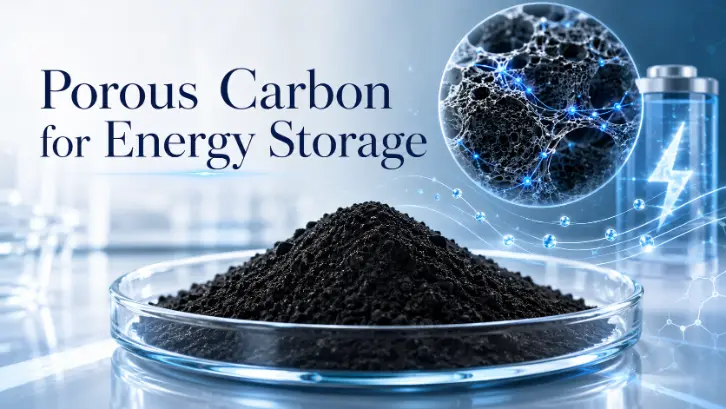
As the global energy storage industry continues to develop, porous carbon materials are receiving increasing attention in supercapacitors, battery-related materials, and other advanced energy storage systems. With high specific surface area, adjustable pore structure, good chemical stability, and tunable surface properties, porous carbon has become an important material platform for next-generation energy storage applications.
However, the performance of porous carbon is not determined by carbon content alone. In many energy storage systems, pore structure, pore size distribution, conductivity, surface chemistry, and long-term stability all influence how ions move, accumulate, and participate in charge storage.
Why Porous Carbon Is Important in Energy Storage
Porous carbon materials are widely studied and used in energy storage because their internal pore network can provide abundant surface area and transport channels. In supercapacitors, for example, ions from the electrolyte need to enter the pores of the carbon material and accumulate at the electrode-electrolyte interface.
This means that a suitable porous carbon material should not only have a high surface area, but also a pore structure that is accessible and well matched with the electrolyte system. If the pores are too narrow, poorly connected, or difficult for ions to enter, part of the surface area may not contribute effectively to performance.
Pore Structure: More Than Just Surface Area
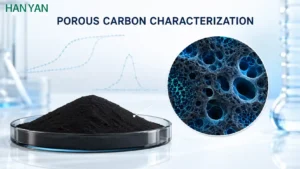
Specific surface area is an important indicator for porous carbon, but it should not be evaluated alone. For energy storage applications, the pore size distribution and pore connectivity are also critical.
Different pore sizes can play different roles in ion storage and transport. A balanced pore structure is often more useful than simply pursuing the highest possible surface area.
| Pore Type | General Role in Energy Storage Materials |
|---|---|
| Micropores | Provide large surface area and active sites for charge storage |
| Mesopores | Support faster ion transport and improve electrolyte accessibility |
| Macropores | Help form transport channels and reduce diffusion resistance in some structures |
For this reason, advanced porous carbon design focuses not only on creating pores, but also on regulating pore structure according to the target application.
Conductivity and Structural Stability
Besides pore structure, electrical conductivity is another important factor. Good conductivity helps reduce internal resistance and supports efficient charge transfer during fast charging and discharging.
Structural stability is also essential. During repeated charge and discharge cycles, the carbon material should maintain its pore structure, mechanical integrity, and electrochemical performance as much as possible. This is especially important for applications that require long cycle life, stable output, and reliable batch performance.
Biomass-Based and Resin-Based Porous Carbon Routes
Different raw materials and preparation routes can result in different porous carbon characteristics. Biomass-based porous carbon is often valued for renewable raw material sources, green development potential, and tunable pore structures. Resin-based porous carbon can offer advantages in structural control, purity, low expansion characteristics, and consistency for high-end applications.
For industrial production, the challenge is not only to prepare high-performance porous carbon in the laboratory, but also to maintain stable quality during scale-up manufacturing. This requires precise control over raw materials, formulation, carbonization, activation, pore regulation, and quality testing.
From Laboratory Development to Industrial Production
As energy storage applications become more specific, porous carbon materials need to move from general adsorption materials toward more application-oriented carbon-based new materials. Performance requirements may vary according to the electrolyte system, device structure, target energy density, power density, cycle life, and production process.
This makes industrial-scale consistency increasingly important. A porous carbon material with excellent laboratory performance still needs stable batch quality, controllable structure, and reliable supply capability before it can support downstream industrial applications.
Industry Connection: HANYAN at CIBF 2026
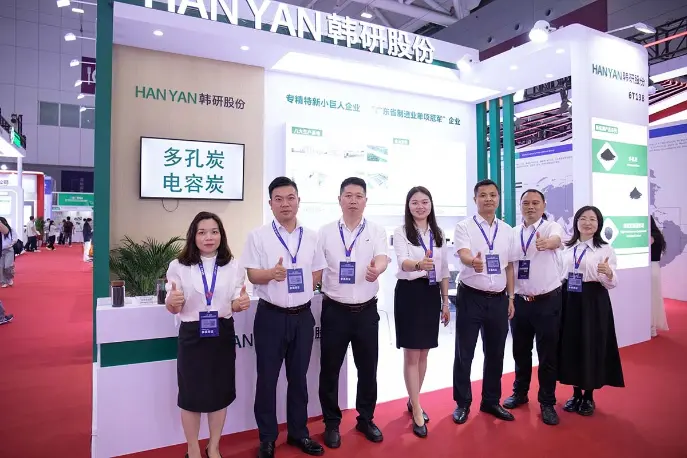
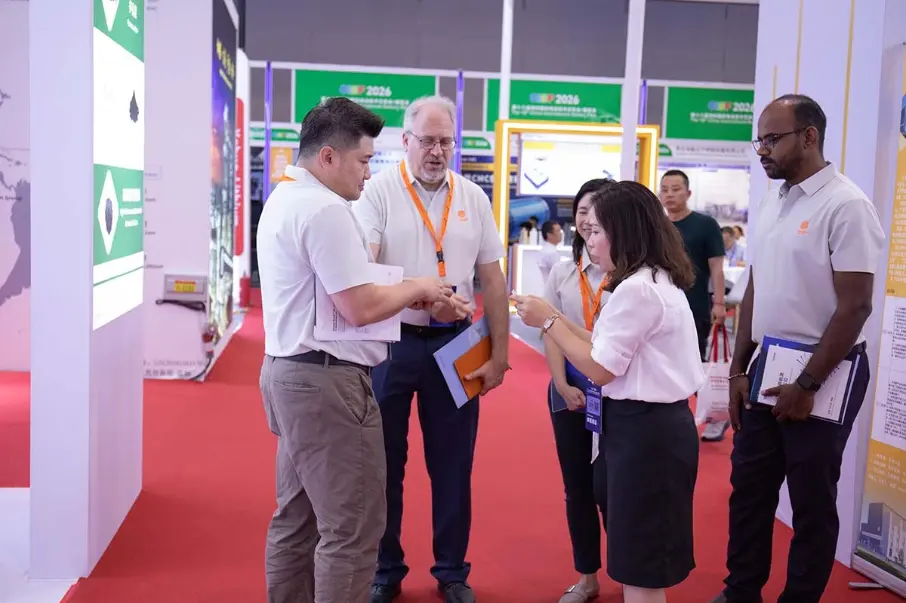
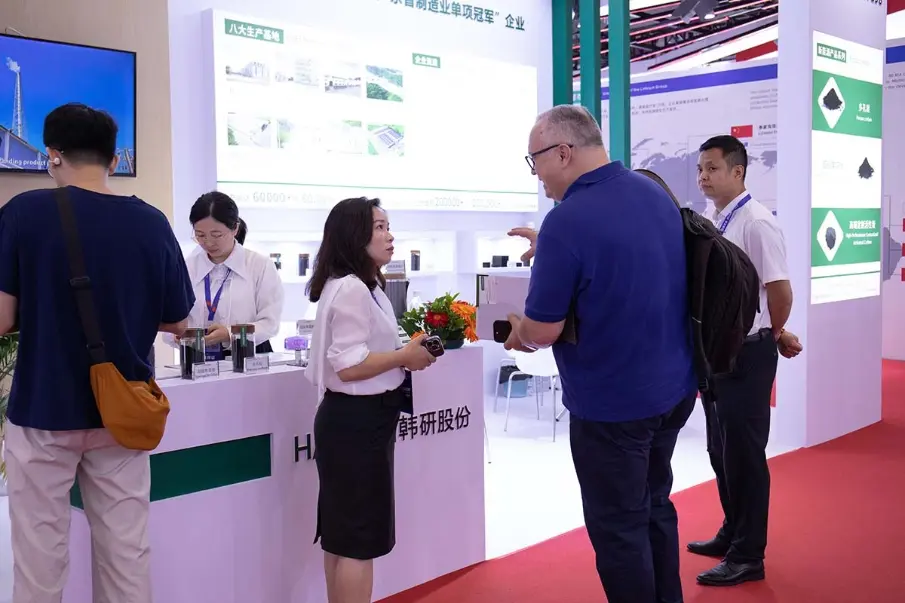
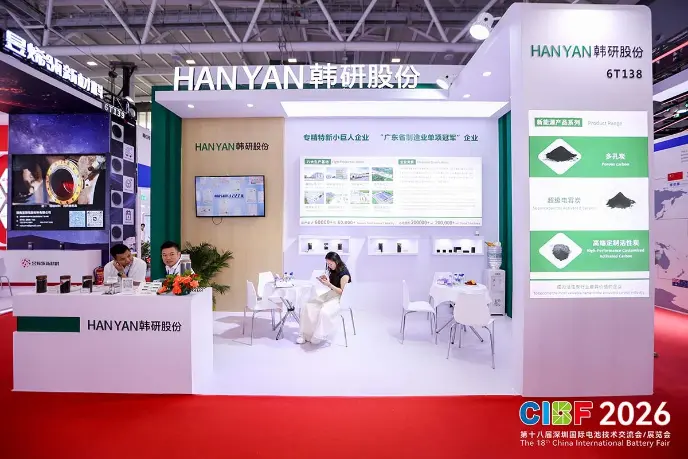
In May 2026, HANYAN participated in CIBF 2026, the 18th China International Battery Fair, held in Shenzhen from May 13 to 15. As one of the major exhibitions for the battery and new energy industry, CIBF brings together companies across the battery value chain, including battery materials, equipment, cell manufacturing, pack technology, and recycling.
For HANYAN, participation in CIBF 2026 was not only an opportunity to observe market trends, but also a way to connect the company’s development in high-performance carbon-based new materials with the growing demand for advanced energy storage materials.
Together with the launch of HANYAN’s thousand-ton-scale energy storage porous carbon production line, this participation reflects the company’s continued commitment to the energy storage materials sector. As application requirements become more specific, porous carbon materials will need to offer more controlled pore structure, stable batch quality, and better process adaptability.
What Makes a Good Energy Storage Porous Carbon?
A suitable porous carbon material for energy storage should be designed according to the target application, electrolyte system, and performance requirement. Several factors are commonly considered:
- Specific surface area: provides active surface for charge storage.
- Pore size distribution: affects ion accessibility and transport efficiency.
- Pore connectivity: helps improve ion diffusion and internal transport.
- Electrical conductivity: supports efficient charge transfer.
- Surface chemistry: influences wettability and electrochemical behavior.
- Structural stability: helps maintain performance during long-term cycling.
- Batch consistency: supports reliable performance in industrial applications.
Conclusion
Porous carbon is an important material platform for energy storage applications. Its value comes not only from high surface area, but also from controlled pore structure, good conductivity, stable surface properties, and reliable production consistency.
As supercapacitors, battery-related materials, and other energy storage technologies continue to develop, the demand for porous carbon materials will become more specific and performance-oriented. Material suppliers need to move beyond general carbon production and focus on structural regulation, process stability, and customized performance design.
HANYAN continues to develop high-performance carbon-based new materials, including porous carbon materials for energy storage applications. Through ongoing research, process optimization, industrial-scale production capability, and active participation in the new energy materials industry, HANYAN aims to provide reliable porous carbon material solutions for advanced energy storage applications.
Article Keywords: porous carbon for energy storage, energy storage porous carbon, porous carbon materials, porous carbon for supercapacitors, porous carbon for battery materials, high surface area carbon, carbon materials for energy storage, pore structure in porous carbon, biomass-based porous carbon, resin-based porous carbon, HANYAN porous carbon, CIBF 2026