Quick Summary (Key Takeaways)
- Beyond Adsorption: Two wood-based powdered activated carbons can have identical iodine numbers and decolorization rates, yet perform completely differently in ionic-sensitive liquids.
- What Conductivity Measures: Water-extract conductivity evaluates the total mobile ionic substances released into a liquid under specific test conditions.
- Not a Substitute for Purity: It does NOT measure dry carbon conductivity, nor does it identify specific metals, salts, or organic impurities.
- Standardized Testing is Key: Results vary significantly depending on test methods. Always specify standards like LY/T 1616-2022 when requesting Certificates of Analysis (COA).
The Hidden Variable in Sensitive Liquid Purification
Imagine evaluating two wood-based powdered activated carbons. Both exhibit identical iodine values, matching color-removal efficacy, and the same particle size distribution. Yet, when introduced into a high-purity liquid stream, one sample performs flawlessly while the other triggers downstream conductivity spikes or contamination alerts.
Why does this happen? Because purification isn’t just about what activated carbon removes – it’s also about what it releases.
For procurement managers, process engineers, and QA specialists in pharmaceutical manufacturing, fine chemicals, and specialty ingredients, relying solely on adsorption metrics is a common pitfall. To ensure zero contamination in controlled applications, evaluating water-extract conductivity is a vital secondary check.
1. What Does Water-Extract Conductivity Actually Measure?
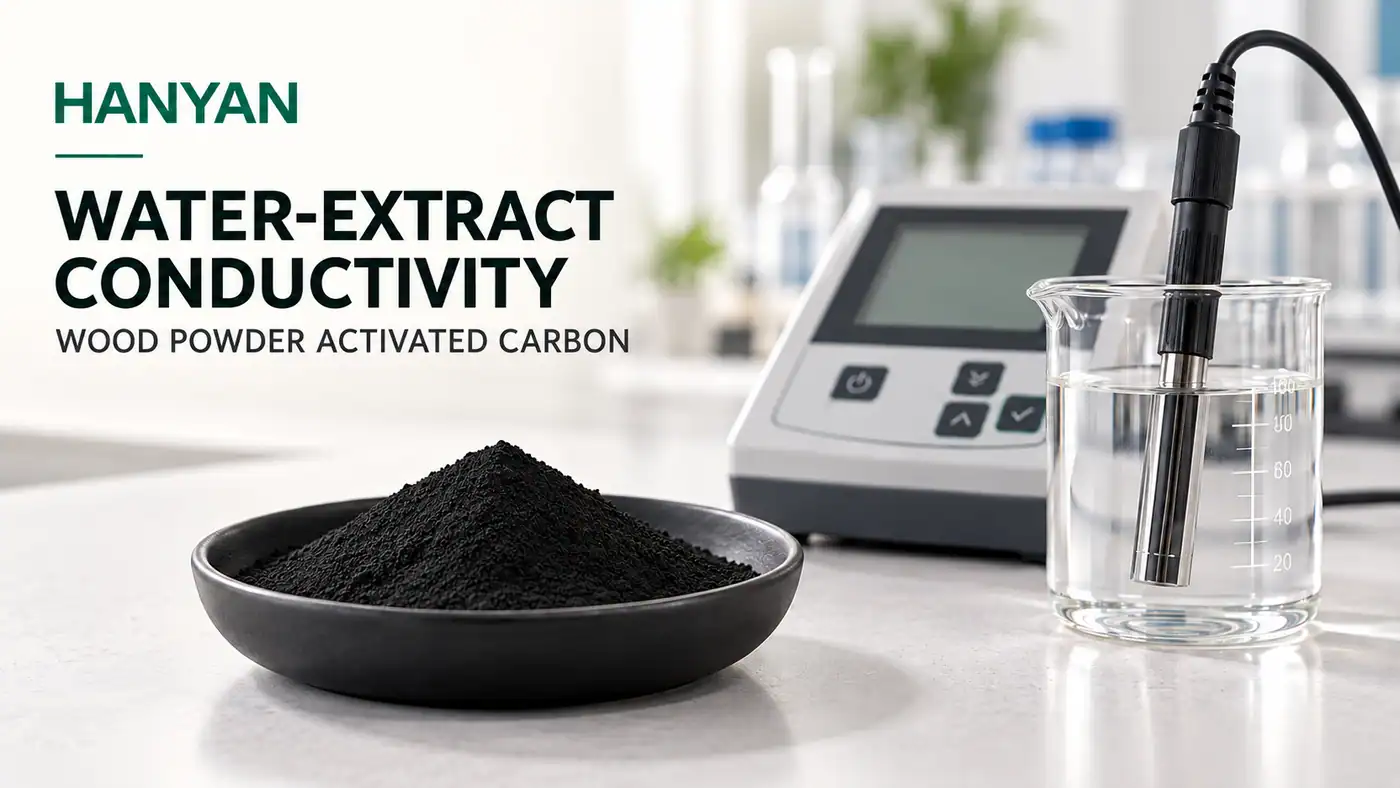
Water-extract conductivity measures how easily a specific water sample conducts electricity after being exposed to activated carbon under strictly defined laboratory conditions.
How It Works
A laboratory contacts a precise mass of activated carbon with purified water, filters out the solid particles, and measures the electrical conductivity of the remaining filtrate – typically expressed in µS/cm (microsiemens per centimeter).
What It TELLS You:
- The relative concentration of dissolved, soluble ionic substances (e.g., traces of inorganic salts or residual wash ions) released into the water.
- A reliable comparative baseline between different carbon batches or suppliers under identical extraction rules.
What It DOES NOT Tell You:
- Dry Electrical Conductivity: It does not measure the electrical conductivity of dry carbon powder.
- Specific Impurity Identification: It cannot tell you which specific ion (e.g., chloride, sulfate, iron) is present.
- Non-Ionic Impurities: Dissolved organic molecules with zero electrical charge will not affect the conductivity reading.
- Adsorption Capacity: A low conductivity reading does not guarantee high decolorization performance.
Key Takeaway: Conductivity is a high-level comparative screening parameter. A high reading indicates potential ionic leaching that warrants targeted chemical analysis, but it is not an automatic pass/fail metric for every application.
2. When Does Water-Extract Conductivity Matter Most?
In high-purity liquid processing, introducing any auxiliary processing agent brings potential risks. Water-extract conductivity is critical whenever downstream processes are sensitive to ionic loads or require strict electrical parameter control.
Primary Use Cases:
- Pharmaceutical Intermediates & APIs: Qualifying new wood-powder carbon grades for regulated batch production.
- Specialty Ingredients & Food Additives: Comparing competing suppliers to prevent unexpected changes in finished product pH or ionic balance.
- Troubleshooting Process Anomalies: Investigating why a filtered liquid failed secondary quality checks following a carbon batch change.
Note: A laboratory water-extract test is a benchmark model. The actual release in your production line depends on your real contact time, liquid matrix, dosage, temperature, and filtration equipment.
3. Water Conductivity vs. Ash, pH, and Water Solubles
To properly assess wood activated carbon, technical buyers should evaluate complementary parameters together rather than treating them as interchangeable.
| Metric | Primary Question Answered | What It Misses On Its Own |
|---|---|---|
| Water-Extract Conductivity | How conductive is the liquid extract after carbon contact? | Specific ion identities or adsorption efficiency. |
| Ash Content | How much inorganic residue remains after complete combustion? | How much of that inorganic material is actually water-soluble. |
| Contact / Extract pH | Is the liquid extract acidic, neutral, or alkaline? | The total ionic volume or identity of dissolved species. |
| Water-Soluble Matter | What total mass dissolves in water under mass-based testing? | Whether the dissolved mass is ionic or non-ionic. |
| Element-Specific Analysis | How much of a specific element (e.g., Fe, Cl⁻) is extracted? | The cumulative presence of unmeasured ions. |
Example: Two carbon products can have the exact same total ash content, but if one contains insoluble silicates and the other contains soluble trace salts, their water-extract conductivity readings will differ drastically.
4. Why Testing Conditions Drastically Alter Results
Comparing conductivity numbers without knowing the underlying test method is misleading. Even subtle changes in laboratory protocol can yield wildly different results:
- Carbon-to-Water Ratio: Varying the ratio changes the concentration of dissolved ions in the sample extract.
- Water Purity & Blank Control: Background ions in laboratory deionized water must be strictly controlled and subtracted.
- Contact Time & Temperature: Extraction kinetics change with temperature. Furthermore, conductivity meter readings themselves are highly temperature-dependent.
- Agitation & Particle Dispersion: The intensity of stirring affects how completely soluble substances leach out.
- Filtration Consistency: Fines or suspended micro-particles left in the extract can interfere with probe readings.
The Standard Reference: LY/T 1616-2022
In China, LY/T 1616-2022 (Test Methods for Wooden Activated Carbon) defines the standard laboratory protocol for measuring water-extract conductivity. When reviewing Certificates of Analysis (COAs), ensure that all comparing samples adhere to LY/T 1616-2022 or an agreed-upon international equivalent (such as standardized ASTM methods).
5. Checklist for Buyers: How to Request Test Data from Suppliers
When sourcing wood powdered activated carbon for sensitive liquid processes, follow this checklist to ensure fair comparisons and reliable batch consistency:
- Define Process Boundaries: Communicate your operating conditions, target purity, and target parameters with your supplier.
- Specify Standardized Methods: Request testing according to a recognized standard (e.g., LY/T 1616-2022) rather than an unspecified “in-house conductivity” test.
- Demand Full Test Reports: Ensure the Certificate of Analysis (COA) includes numerical values, units, sample batch numbers, testing temperature, and exact protocol details.
- Combine Strategic Tests: Request a holistic analysis including pH, ash content, water solubles, and heavy metal limits.
- Conduct Application-Specific Pilot Testing: Test candidate carbon samples in your actual process liquid at representative dosages and contact times to measure both purification efficacy and final filtrate conductivity.
- Lock In Lot-to-Lot Consistency: Establish clear sampling protocols and standard acceptance thresholds for ongoing commercial orders.
6. How HANYAN Helps You Select the Right Activated Carbon Grade
At HANYAN, we understand that wood powdered activated carbon selection extends far beyond standard iodine adsorption numbers. Selecting the optimal grade requires balancing adsorption capacity with chemical purity.
Our Approach to Grade Qualification:
- Application Review: We analyze your liquid matrix, purification target, and process sensitivities.
- Standardized Laboratory Testing: Samples are evaluated under strict standards like LY/T 1616-2022 to generate reliable, reproducible data.
- Real-Process Verification: We work alongside your technical team to validate performance using your actual process liquid before full-scale deployment.
- Batch-to-Batch Quality Assurance: Every shipment is locked to agreed specifications, ensuring reliable performance lot after lot.
⚠️ Quality Commitment Note: We never infer conductivity numbers strictly from iodine values or manufacturing routes. Conductivity metrics are supplied only after verified testing under agreed-upon protocols.
Conclusion
Water-extract conductivity is a precise, valuable indicator of how activated carbon interacts with liquid streams. By combining conductivity data with ash, pH, and adsorption metrics, technical buyers can make fully informed qualification decisions, protect downstream processes, and guarantee product quality.
Looking for the ideal wood powdered activated carbon grade for your process?
Contact the HANYAN Technical Team today to request tailored sample testing, Certificate of Analysis (COA) documentation, or technical consultations.
Article Keywords: wood powder activated carbon conductivity, water-extract conductivity, activated carbon water extract, LY/T 1616-2022, soluble impurities in activated carbon, pharmaceutical activated carbon testing, wood-based powdered activated carbon quality control