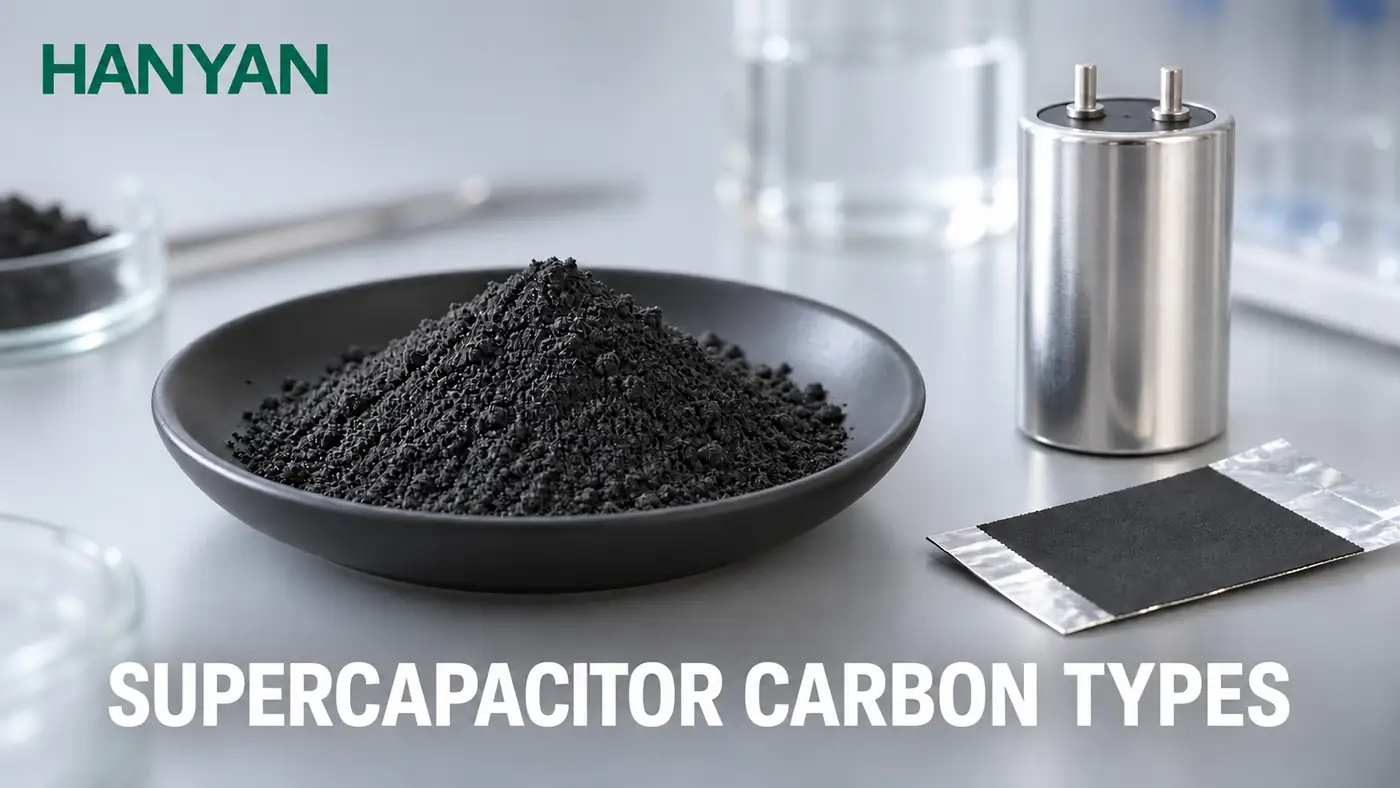
“Supercapacitor carbon” covers a wide range of materials, but they are not equally common in commercial electric double-layer capacitors (EDLCs). Fine-powder activated carbon remains a widely used electrode material because it provides a useful combination of porous surface, manufacturability and cost. Buyers may also encounter activated carbon fibers and newer carbon materials, often for more specialized designs.
Even within activated carbon, the precursor makes a difference. Coconut shell, coal, pitch and synthetic resins can all be turned into porous electrode carbons, but none has a guaranteed advantage in every device. Activation, purification, pore design, electrode processing and electrolyte choice can matter as much as the starting material. This article compares the main options and explains which data to request before choosing a grade.
Contents
- What makes a carbon suitable for an EDLC?
- Four activated-carbon precursor groups
- Activated carbon fiber and emerging alternatives
- Comparison of advantages and limitations
- How to compare candidate materials
- How HANYAN approaches custom carbon development
1. What Makes a Carbon Suitable for an EDLC?
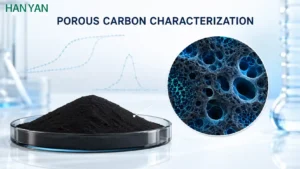
In an EDLC, ions from the electrolyte accumulate at the electrode surface during charging. The carbon therefore needs pores that the chosen ions can enter, pathways that let them move quickly, and a structure that can be processed into a stable electrode. A high BET surface area is useful information, but it does not show by itself whether that surface is accessible to the electrolyte or how a complete device will perform.
Key properties include pore-size distribution, surface chemistry, particle size, purity, electrical resistance and electrode packing density. Micropores can provide storage area, while a suitable transport network helps ions reach that area at higher charge and discharge rates. Pore size must be considered together with the electrolyte: a carbon optimized for one ion and solvent system may perform differently in another.
There is also a trade-off between performance per gram and performance per unit volume. An exceptionally porous, low-density powder may show attractive gravimetric capacitance while occupying too much space in the finished device. Practical selection requires both material data and electrode- or cell-level testing.
2. Four Activated-Carbon Precursor Groups
Coconut-shell-derived activated carbon
Coconut-shell carbon is an established natural-precursor option for EDLC electrode powders. Commercial examples demonstrate that, after suitable activation and processing, it can be produced in grades for different capacity and resistance requirements. Its feedstock availability and industrial processing experience can support cost-effective volume supply.
Potential advantages: mature supply chains, good potential for fine powder production and a useful base for tailored microporosity. Points to check: the pore distribution must match the electrolyte; an overly narrow or poorly connected pore system may slow ion transport. Ash, residual impurities and batch consistency still require control. A coconut-shell origin alone does not prove that the material is battery-grade.
Coal-derived activated carbon
Coal is another available carbon precursor. Appropriate selection, activation and purification can produce a wide range of porous structures. It may be attractive where cost and feedstock scale matter, but grades made for water or air treatment should not automatically be treated as EDLC electrode carbons.
Potential advantages: broad precursor availability and flexibility to tune pore development. Points to check: mineral matter and other impurities can require more intensive purification; precursor variation and processing choices affect final consistency. The buyer should evaluate the actual electrode grade, not infer performance from “coal-based” on a product label.
Pitch-derived porous carbon
Coal-tar or petroleum pitch can be processed into porous carbon for capacitor electrodes. Research shows that activation and pore engineering can produce useful capacitance and ion-transport properties. Depending on the formulation and process, pitch-derived carbons may also offer possibilities for controlling carbon structure and electrode density.
Potential advantages: a versatile industrial carbon precursor and scope to engineer the balance of porosity and packing behavior. Points to check: feedstock composition and thermal processing need careful control; high surface area or a favorable laboratory result does not guarantee economical large-scale production or low cell resistance.
Resin-derived activated carbon
Synthetic precursors, including phenolic and other resins, allow the starting chemistry and sometimes particle shape to be selected more deliberately. Resin-derived carbons can be developed for targeted pore structures, controlled morphology and stringent purity requirements. This makes them relevant when a customer needs performance characteristics that are difficult to obtain consistently from a standard natural precursor.
Potential advantages: design flexibility in the precursor and potential for consistent, specialized grades. Points to check: precursor and processing costs may be higher; activation, washing, yield and scale-up all affect the final economics. “Resin-based” is not itself a performance specification—electrochemical results still need to be confirmed in the intended system.
3. Activated Carbon Fiber and Emerging Alternatives
Activated carbon fiber (ACF) can be used in fabric or felt electrode structures. It offers a different route from loose powder and has an established history in EDLC products. Its form may simplify certain electrode architectures, but material cost, packing, electrical contact and suitability for a given device design must be evaluated. It should not be compared with powder carbon only by quoting a BET value.
Graphene, carbon nanotubes, carbon aerogels and carbide-derived carbons are important in research and selected high-performance or specialty designs. Some are used as conductive additives or in composites rather than as a direct substitute for all activated carbon in a large-volume EDLC electrode. Their potential advantages include tailored transport pathways or carefully controlled pore structures; challenges may include cost, packing density, processing and scaling. It would be misleading to describe them as equally common replacements for commercial activated-carbon powders.
4. Advantages and Limitations at a Glance
| Carbon type | Typical appeal | Main selection question |
|---|---|---|
| Coconut-shell activated carbon | Mature commercial powder route; natural precursor | Do pore access, impurity level and batch consistency fit this electrolyte? |
| Coal-derived activated carbon | Available precursor; scope for pore engineering | Has mineral content been controlled, and is this an electrode grade? |
| Pitch-derived porous carbon | Potential to tune carbon structure and pore network | Can the laboratory result be reproduced economically at scale? |
| Resin-derived activated carbon | Tailored precursor chemistry and morphology | Does the added design control justify the total electrode cost? |
| Activated carbon fiber | Fabric or felt electrode architecture | Does its structure improve the complete device after contact and packing are considered? |
These are tendencies, not universal rankings. Activation method, purification and electrode fabrication can change the outcome within any category. A brand name also does not necessarily identify the feedstock: request the manufacturer’s actual product specification when precursor origin matters.
5. How to Compare Candidate Supercapacitor Carbons
A technical comparison should start with the intended device rather than a single headline number. Ask suppliers to provide material specifications and test results under comparable conditions:
- Electrolyte and voltage window: aqueous, organic and ionic-liquid systems can behave differently with the same carbon.
- Pore structure: BET surface area, pore-size distribution and accessible pore volume are more informative together than BET alone.
- Powder properties: particle-size distribution, ash or relevant impurities, moisture and packing behavior affect manufacturing.
- Electrode formulation: carbon loading, binder, conductive additive, thickness and density influence the measured result.
- Electrochemical tests: compare capacitance, equivalent series resistance (ESR), rate performance and cycling under the same test protocol.
- Reporting basis: distinguish per-electrode from full-cell values, and gravimetric from volumetric figures.
Three-electrode measurements can be useful for screening materials, but they should not be compared directly with a two-electrode device value as though the test conditions were identical. For a purchase decision, results in a representative two-electrode cell and an agreed electrode recipe are particularly useful. A material with the highest capacitance per gram may not be the best option if electrode density, resistance, consistency or total cost does not meet the project target.
6. How HANYAN Approaches Custom Carbon Development
HANYAN develops porous carbon materials for energy-storage applications, including resin-based options. For a new supercapacitor project, the useful starting point is the customer’s electrolyte, electrode process and target for capacity, resistance, density and cost. This allows candidate materials to be evaluated against the same device requirements.
We can discuss product parameters, provide samples for the customer’s electrode trials and review feedback from comparable testing. Specific performance claims should be based on the grade and test conditions involved rather than on the precursor name alone.
Conclusion
Commercial EDLCs commonly use fine-powder activated carbon, while the precursor and processing route vary. Coconut shell offers a proven commercial path; coal and pitch provide other feedstock options; resin-derived carbon supports more deliberately tailored grades; and ACF serves different electrode architectures. Graphene, nanotubes and other engineered carbons remain important options for particular designs and research.
The best carbon is the one that performs reliably in the intended electrolyte and electrode configuration at an acceptable total cost. Compare pore structure, purity, packing and complete-cell data before selecting a supercapacitor carbon grade.
Article Keywords: supercapacitor carbon types, activated carbon for supercapacitors, EDLC electrode carbon, coconut-shell capacitor carbon, coal-based capacitor carbon, pitch-derived porous carbon, resin-based supercapacitor carbon