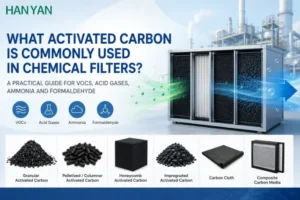
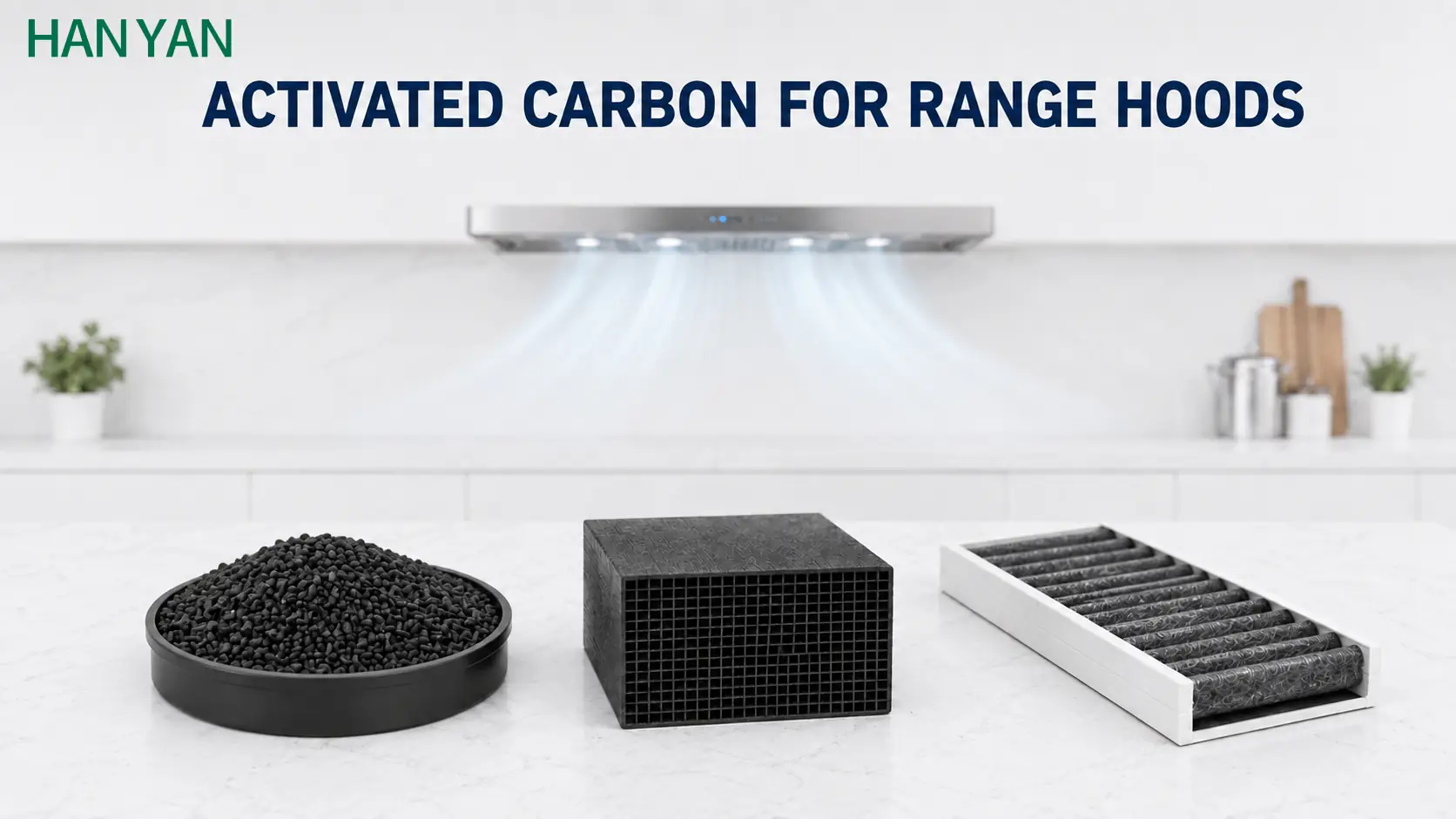
Activated carbon filters are commonly used in ductless or recirculating range hoods to reduce cooking odors before the air is returned to the kitchen. Although these filters may look very different, their main purpose is similar: to adsorb odor-causing gaseous compounds that cannot be effectively removed by a conventional metal grease filter alone.
Depending on the filter structure, available installation space and airflow requirements, range hood manufacturers may use pellet activated carbon, customized honeycomb activated carbon or carbon-loaded nonwoven media. Understanding the differences between these materials is important when designing or selecting a suitable kitchen hood filter.
Why Is Activated Carbon Used in Range Hoods?
Kitchen exhaust contains a combination of oil droplets, fine particles, moisture and gaseous odor compounds. These pollutants should not all be handled by the same filter material.
A typical recirculating range hood therefore uses multiple filtration stages:
- Metal grease filter: captures larger oil droplets, grease and particulate matter.
- Activated carbon filter: adsorbs cooking odors and some gaseous organic compounds.
- Optional fine-particle filter: provides additional particle control in certain designs.
The grease filter is particularly important because activated carbon is not intended to serve as the primary oil collector. If large amounts of grease reach the carbon layer, they may cover the carbon surface, block its pores and shorten its effective service life.
1. Pellet or Granular Activated Carbon
Pellet and granular activated carbon are commonly enclosed inside a plastic, metal or nonwoven filter cartridge. Pellet activated carbon usually consists of small cylindrical particles, while granular activated carbon has a more irregular particle shape.
This type of filter can contain a relatively substantial amount of activated carbon within a compact cassette. As cooking air passes through the cartridge, odor molecules contact the carbon particles and are retained within their pore structure.
Main characteristics include:
- Relatively high carbon loading
- Good adsorption capacity when sufficient contact time is provided
- Flexible use in round, rectangular or custom filter cartridges
- Easy replacement as a complete filter module
However, particle size, filling density and cartridge design must be properly balanced. Very dense filling may increase airflow resistance, while poor distribution may create empty spaces that allow air to bypass the carbon.
2. Customized Honeycomb Activated Carbon
Honeycomb activated carbon is formed into a rigid block containing multiple straight airflow channels. For range hood applications, its dimensions, thickness and channel density can be customized to fit the available internal space.
Compared with loose carbon particles, the structured channels help keep the adsorption material stable and support relatively uniform airflow. This makes customized honeycomb activated carbon useful for filter designs that require:
- Low airflow resistance
- A stable, dust-controlled structure
- Consistent product dimensions
- Convenient installation in modular filter housings
- Customized shapes or thicknesses for OEM projects
Honeycomb structure alone does not determine adsorption performance. Carbon content, pore structure, block thickness, airflow velocity and actual contact time must also be considered. A lightweight honeycomb block with insufficient activated carbon may provide less effective odor control than expected, even if its appearance is similar to a higher-quality product.
3. Carbon-Sandwiched Nonwoven Media
Carbon-sandwiched nonwoven media, sometimes referred to commercially as carbon cloth or activated carbon fabric, generally consists of activated carbon particles bonded to or enclosed between nonwoven layers.
This material is thin, lightweight and easy to cut into different shapes. It can be laminated with foam, synthetic fiber, mesh or other supporting materials to produce compact range hood filter panels.
Its main advantages include:
- Small installation thickness
- Low weight
- Easy die-cutting and lamination
- Suitable for irregular or limited filter spaces
- Convenient integration into disposable filter panels
The main limitation is that thin nonwoven media usually contains less activated carbon than a deep pellet-filled cartridge or a thick honeycomb carbon block. Its service life therefore depends heavily on carbon loading, filter area, cooking frequency and odor concentration.
Comparison of Activated Carbon Materials for Range Hoods
| Carbon Type | Main Advantages | Main Considerations | Typical Filter Design |
|---|---|---|---|
| Pellet or Granular Activated Carbon | Higher carbon loading and flexible cartridge design | Filling uniformity, dust control and airflow resistance | Round or rectangular carbon cassette |
| Honeycomb Activated Carbon | Stable structure, straight airflow channels and customizable dimensions | Carbon content, block thickness, channel density and sealing | Rigid modular carbon block |
| Carbon-Sandwiched Nonwoven | Thin, lightweight and easy to cut or laminate | Lower carbon loading in very thin filter designs | Flat disposable filter pad or laminated panel |
Different Forms, the Same Adsorption Principle
Pellet carbon, honeycomb carbon and carbon-loaded nonwoven media have different appearances and structural characteristics, but they all rely mainly on adsorption.
Activated carbon contains a highly developed internal pore network. When odor-containing air passes through the filter, gaseous molecules enter these pores and are retained on the internal carbon surface. The effectiveness of the filter therefore depends not only on the type of carbon, but also on how much usable carbon is present and how effectively the airflow contacts it.
A larger-looking filter does not necessarily provide better performance. Carbon quality, carbon loading, contact time, airflow distribution and sealing are all important.
How to Select the Right Carbon Material
Range hood manufacturers and filter suppliers should evaluate the following factors before selecting an activated carbon format:
- Ventilation mode: activated carbon is especially important in ductless and recirculating systems.
- Available filter space: thin spaces may favor carbon-loaded nonwoven media, while deeper housings can accommodate pellet cartridges or honeycomb blocks.
- Airflow and pressure drop: the filter must provide sufficient gas-carbon contact without excessively restricting airflow.
- Carbon loading: more effective carbon mass generally provides greater adsorption potential when the filter is properly designed.
- Grease protection: an effective upstream grease filter helps prevent premature carbon fouling.
- Dimensions and sealing: the filter should fit closely inside the housing to prevent untreated air from bypassing the carbon.
- Replacement requirements: the product should be easy for users to inspect and replace.
When Should a Range Hood Carbon Filter Be Replaced?
There is no universal replacement interval for every range hood carbon filter. Service life depends on cooking frequency, cooking method, odor load, airflow, filter size and the amount of activated carbon used.
Many conventional carbon filters are replaced after several months of normal household use, but the appliance manufacturer’s instructions should always be followed. A noticeable return of cooking odors after the hood has been operating can also indicate that the carbon is approaching saturation.
Standard disposable carbon filters should not automatically be washed with water. Washing may damage the filter structure without restoring the occupied adsorption pores. Only filters specifically designed and labeled as washable or regenerable should be treated in this way.
Conclusion
Activated carbon used in range hood filters does not have one fixed form. Pellet or granular carbon offers flexible filling and relatively high carbon loading, customized honeycomb activated carbon provides a stable low-resistance structure, and carbon-sandwiched nonwoven media is well suited to thin and lightweight filter designs.
Although these materials look different, their final purpose is the same: to adsorb cooking odors and improve the quality of recirculated kitchen air. The best option should be selected according to the filter dimensions, airflow, carbon loading, grease protection and expected service life rather than appearance alone.
HANYAN supplies different activated carbon materials and supports customized solutions for range hood and air-filtration projects. Based on the customer’s filter structure, dimensions, airflow and adsorption requirements, our technical team can assist with the selection of pellet activated carbon, customized honeycomb activated carbon and carbon-containing filter media.
Article Keywords: activated carbon for range hood filters, cooker hood carbon filter, range hood charcoal filter, pellet activated carbon, honeycomb activated carbon, carbon-sandwiched nonwoven, activated carbon cloth, kitchen odor filter, ductless range hood filter, recirculating cooker hood