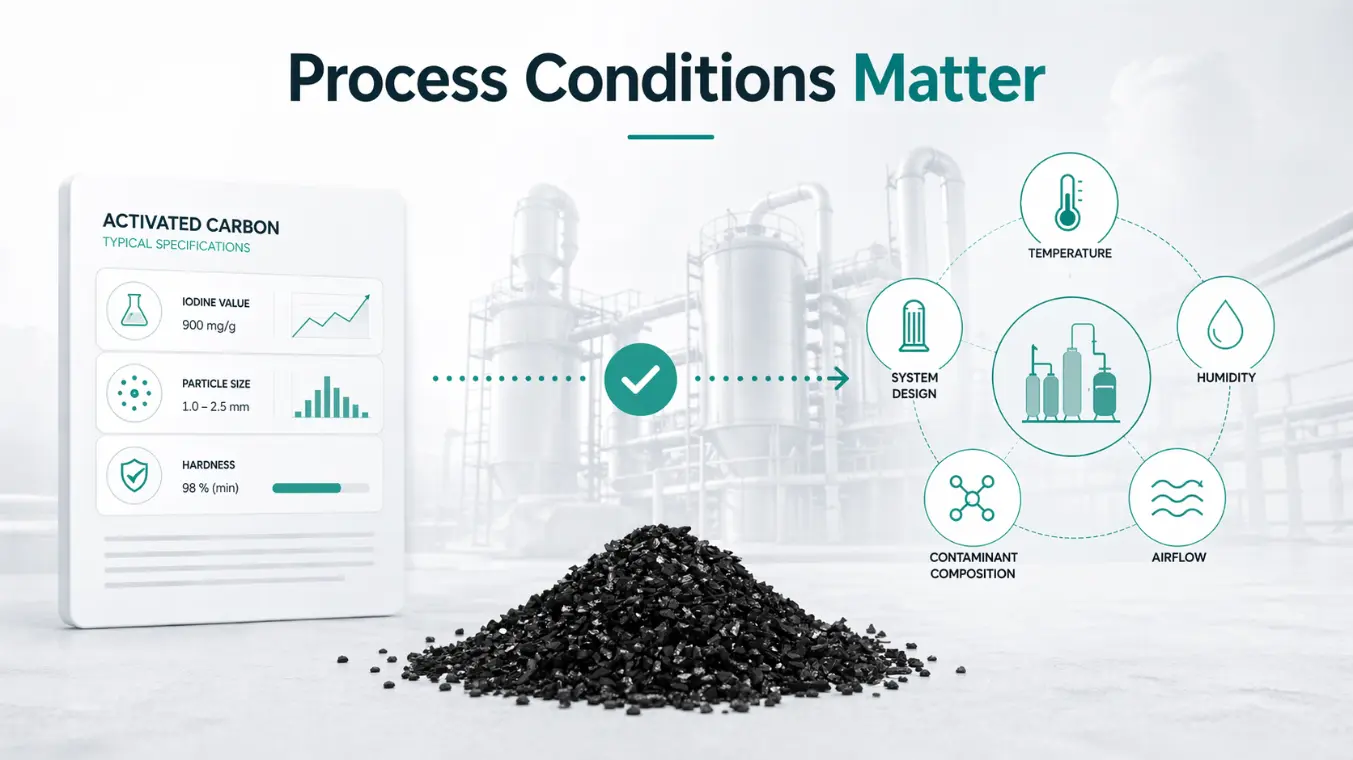
Activated carbon is often compared through specification sheets, where buyers look at specifications such as iodine value, surface area, hardness, particle size, or other standard data. These parameters are useful, but they do not tell the full story of how a activated carbon will perform in a real industrial system.
In practice, activated carbon performance is strongly influenced by process conditions/working conditions. The same product may work well in one application and perform only moderately in another, even when the target pollutant appears similar. That is why carbon selection should be based not only on datasheet values, but also on the actual operating environment.
Why Datasheet Values Are Helpful but Not Sufficient
Technical datasheets are important because they provide a basic description of the material. They help users compare products at a general level and understand whether a carbon may be suitable for a certain type of application.
However, a datasheet is still a simplified representation. It cannot fully reflect how the carbon will behave when exposed to real contaminant mixtures, changing temperatures, varying humidity, unstable airflow, or system-specific pressure and contact time conditions.
This is especially important in industrial applications, where treatment systems rarely operate under perfectly controlled laboratory conditions.
Process Conditions Can Change Adsorption Performance Significantly
Activated carbon adsorption depends on more than the adsorbent itself. In real systems, performance may be influenced by:
- Contaminant composition – different compounds interact differently with activated carbon.
- Concentration level – adsorption behavior changes as pollutant loading changes.
- Temperature – higher temperature can reduce adsorption favorability.
- Humidity – moisture may compete with target compounds in some applications.
- Airflow and contact time – system design affects how effectively pollutants contact the carbon bed.
- Pretreatment condition – dust, oil mist, or condensable substances may reduce usable capacity.
These specifications help explain why a carbon with attractive numbers on paper does not always produce the expected result in the field.
Different VOCs Do Not Behave the Same Way
One of the most common oversimplifications in carbon selection is assuming that “VOC removal” is a single performance category. In reality, different VOCs have different molecular properties, adsorption affinities, and competitive behaviors.
Even when two systems are both described as VOC treatment, the actual adsorption demand may differ greatly depending on whether the gas stream contains solvents, mixed organics, intermittent peaks, or compounds that behave differently under humidity or temperature change.
This means a general-purpose comparison based only on one specification value may overlook the real adsorption challenge.
Temperature and Humidity Can Shift Real Performance
Operating conditions matter because adsorption is not fixed across all environments. In many applications, higher temperature can reduce equilibrium adsorption capacity, while humidity may interfere with performance depending on the contaminant system and the structure of the carbon.
As a result, a carbon that appears suitable in a dry and mild operating environment may show earlier breakthrough or lower stability in hotter or more humid conditions.
This is one reason why carbon selection should be discussed together with process conditions rather than separated from them.
System Design Matters Just as Much as Material Choice
Activated carbon does not work in isolation. Its real performance depends on how it is used inside a treatment system. Airflow distribution, bed depth, residence time, pretreatment, changeout strategy, and operational stability all influence the final result.
In some cases, users may blame the carbon when the real limitation comes from insufficient contact time, poor pretreatment, or large fluctuations in contaminant load. In other words, material choice and system design should be evaluated together.
Why Application-Based Selection Leads to Better Decisions
For industrial users, the most reliable approach is application-based evaluation. Instead of asking only “Which carbon has the higher number?”, it is usually more useful to ask:
- What contaminants are actually present?
- Are concentrations stable or variable?
- What are the temperature and humidity conditions?
- How is the system designed and operated?
- What service life and replacement logic are required?
- Is the priority adsorption capacity, filtration performance, purity, or operational stability?
These questions lead to a more realistic selection process and help reduce the risk of choosing a carbon that looks strong on paper but is poorly matched to the actual application.
Activated Carbon Selection Should Be a Process Decision
Activated carbon is part of a process, not just a standalone material purchase. The best product is not always the one with the highest advertised indicator, but the one that fits the actual treatment conditions and performs consistently in the specific system.
For this reason, industrial users should treat carbon selection as a process decision that combines material data, contaminant characteristics, operating conditions, and system design requirements.
Conclusion
Datasheet values remain useful, but they should be viewed as a starting point rather than the final basis for activated carbon selection. Real adsorption performance depends on process conditions such as contaminant type, concentration, temperature, humidity, airflow, and overall system design.
In industrial practice, better results usually come from matching the carbon to the real operating environment, not from relying on a specification sheet alone. A process-based selection approach can improve performance predictability, reduce operational risk, and support more effective long-term use of activated carbon.
Further Reading
- U.S. EPA – Chapter 1: Carbon Adsorbers
- U.S. EPA – Carbon Adsorbers Guidance
- U.S. EPA – Statement of Basis and Summary for VOC Adsorption Control
Article Keywords: activated carbon selection, process conditions, activated carbon datasheet, VOC adsorption performance, industrial activated carbon, adsorption system design, carbon selection strategy, activated carbon operating conditions