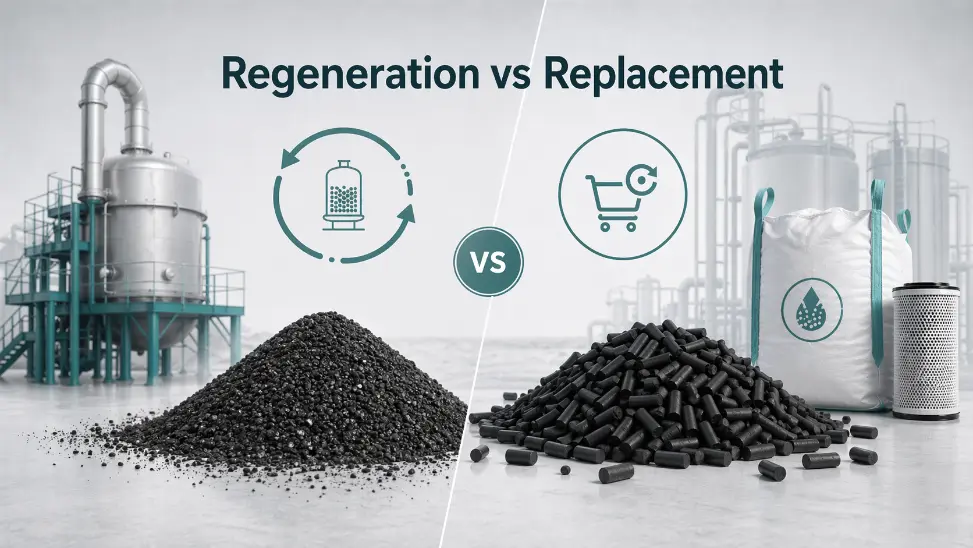
For many industrial users, activated carbon is not a one-time materials decision. After the carbon becomes spent, the next question is whether it should be regenerated for reuse or replaced with new carbon. In practice, this is not simply a price comparison. The better choice depends on the application, the contaminant profile, the required performance stability, and the operational risks around handling spent media.
Activated carbon has long been used in liquid and gas purification across a wide range of industrial and environmental applications. In some cases, spent carbon can be reactivated and returned to service economically. At the same time, regeneration outcomes are not identical in every case, and industrial users should evaluate regeneration as a system decision rather than assuming it will always perform exactly like fresh material.
Why This Decision Is More Than a Media Cost Question
At first glance, regeneration may appear attractive because it can reduce waste, conserve resources, and lower the long-term burden associated with spent-carbon disposal. In suitable cases, it may also help reduce overall operating cost and support a more circular materials strategy.
However, industrial users are rarely buying carbon alone. They are managing a treatment system, an emissions target, a product quality requirement, or a production process. That means the true comparison is not just regeneration price versus new-carbon price, but rather total operating outcome versus total operating risk.
When Regeneration Can Make Strategic Sense
Regeneration is often most attractive when carbon usage is continuous, spent-media volumes are significant, and the application is stable enough for reuse cycles to be operationally manageable.
It may also be attractive when the user wants to reduce disposal volume and maintain a more sustainable materials strategy. In these situations, regeneration can be more than a cost-saving measure; it can also become part of long-term process management.
Why Replacement May Still Be the Better Choice in Some Cases
Replacement with new activated carbon can be the better option when the user needs more predictable adsorption performance, when contaminant composition is highly variable, or when the cost of process instability is higher than the savings from reuse.
New carbon reduces uncertainty around retained capacity, pore-structure damage, and the cumulative effect of multiple service cycles. It may also be operationally simpler when turnaround time is critical, logistics are difficult, or the spent carbon contains contaminants that create handling, transportation, or destruction concerns.
Performance Retention Is One of the Core Questions
The central technical issue is straightforward: How much useful performance does regenerated carbon retain? That answer depends on the regeneration method, the adsorbed compounds, and the carbon’s pore structure.
Even when regeneration is technically successful, “successful” does not always mean “equivalent to fresh carbon.” A regenerated product may still be fully acceptable for some applications, while other applications with stricter breakthrough margins or purity demands may be more sensitive to even modest performance decline.
That is why industrial users should ask not only whether regeneration works, but whether it works well enough for the specific process requirement.
Cost Should Be Measured as Total Treatment Cost
A practical comparison should include more than media price. Industrial users should consider at least five cost layers: new or regenerated filtration media cost, freight and handling, changeout labor, downtime or reduced throughput risk, and waste disposal or spent-media management.
In some operations, the hidden cost of instability can exceed the apparent savings of lower media cost. For users in highly regulated environments, another cost layer is compliance exposure. If regenerated carbon shortens service life or changes breakthrough behavior enough to affect emissions or product quality, the resulting operational cost may outweigh the savings from reuse.
Risk Evaluation Often Decides the Outcome
In many plants, the final decision is driven less by average cost and more by acceptable risk.
Users should evaluate questions such as: How stable is the contaminant profile? How costly is an unplanned breakthrough? How quickly can replacement media be supplied? How difficult is spent-carbon handling? How much performance variation can the process tolerate?
These are often more decisive than the nominal price difference between regenerated and virgin carbon.
A Practical Evaluation Framework for Industrial Users
Instead of treating regeneration and replacement as a general preference, industrial users can evaluate the decision using a simple framework:
- Application fit: Is the service well suited to regeneration, or does it demand fresh-carbon consistency?
- Performance margin: How much capacity loss or breakthrough shift can the system tolerate?
- Contaminant complexity: Are the adsorbed compounds relatively straightforward, or do they introduce additional handling and disposal concerns?
- Logistics and lead time: Which option better supports plant continuity?
- Total cost: What is the full cost after labor, freight, downtime, and disposal are included?
- Compliance and liability: Which option carries lower long-term operational exposure?
This kind of framework usually leads to a better decision than relying on a simple “reuse is cheaper” or “new is safer” assumption.
Conclusion
Activated carbon regeneration versus replacement is best viewed as an industrial decision about cost, risk, and required performance, not just a purchasing choice.
Regeneration can be highly valuable when the application is suitable, the reuse pathway is well controlled, and the retained performance matches process needs. Replacement can be the better strategy when predictability, tighter performance margins, or contaminant-related risk make fresh media the safer operational choice.
In practice, the most useful question is not “Which is cheaper?” but “Which option delivers the best total treatment outcome for this specific system?” Industrial users who evaluate regeneration and replacement through that lens usually make better long-term decisions.
Further Reading
- Activated Carbon Reactivation and Industrial Application Overview
- EPA Guidance on Carbon Adsorption in VOC Control Systems
- EPA Guidance on PFAS Destruction and Disposal Pathways
- Study on Adsorption Capacity Changes After Regeneration Cycles
Article Keywords: activated carbon regeneration vs replacement, spent activated carbon, carbon reactivation, industrial adsorption systems, activated carbon lifecycle cost, activated carbon performance retention, VOC carbon regeneration, carbon replacement strategy