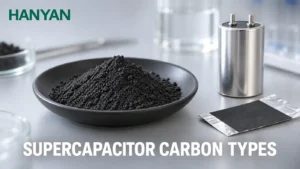
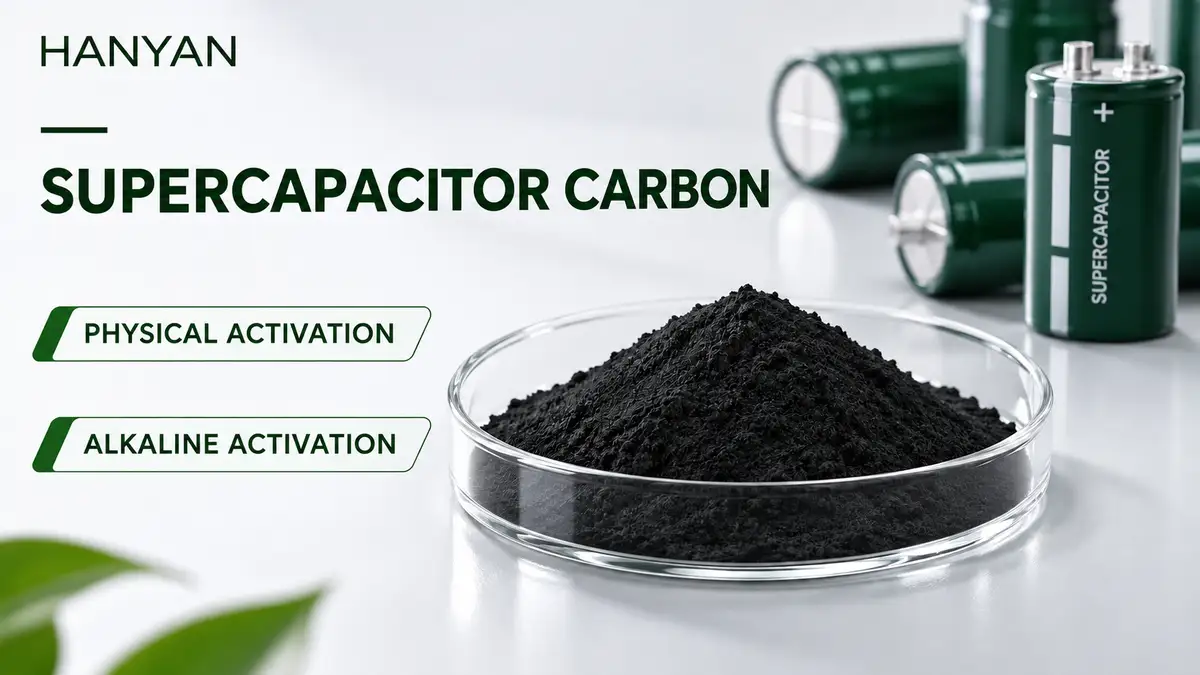
Supercapacitors are used in applications that require rapid charging and discharging, high power output, and repeated cycling. As a key electrode material, activated carbon plays an important role in determining how effectively a supercapacitor stores and delivers energy.
However, supercapacitor manufacturers do not all have the same material requirements. Differences in electrolyte, electrode design, processing methods, and performance targets mean that a single activated carbon specification may not suit every project.
To support different development and production needs, HANYAN offers supercapacitor activated carbon through two activation routes: physical activation and alkaline chemical activation.
Why Is Activated Carbon Used in Supercapacitors?
In an electric double-layer capacitor, energy is stored through the separation of electrical charges at the interface between the electrode and electrolyte.
Activated carbon is widely used in these electrodes because it can provide a large internal surface area and a porous structure accessible to electrolyte ions.
The performance of the carbon depends on more than its total surface area. Pore size distribution, pore accessibility, electrical conductivity, density, purity, and the compatibility between the carbon and electrolyte are also important.
HANYAN’s Two Activation Routes
Activation creates and develops the internal pore structure of carbon materials. Different activation routes and processing conditions can produce materials with different characteristics.
HANYAN has both physical activation and alkaline chemical activation capabilities for supercapacitor carbon. These two routes provide more options when developing products for different customer requirements.
1. Physical Activation
Physical activation develops porosity through controlled reactions between carbon and an activating gas at elevated temperatures. Steam and carbon dioxide are examples of activating gases used in the industry.
The resulting pore structure depends on factors such as the raw material, activation temperature, gas conditions, and degree of activation.
Through process control, physically activated carbon can be developed for applications with specific requirements for pore structure, density, and other material properties.
2. Alkaline Chemical Activation
Alkaline chemical activation uses an alkaline activating agent to promote pore development in the carbon material. Potassium hydroxide and sodium hydroxide are examples of agents used in the industry.
The choice of activating agent, its amount, processing conditions, and subsequent washing and purification can all influence the final material.
This route provides another way to develop carbon materials with different pore structures and properties for supercapacitor electrode applications.
The examples above describe activation methods used in the industry. The specific process and product configuration should be discussed according to the customer’s requirements.
Physical vs. Chemical Activation: What Is the Difference?
Both activation routes can produce porous carbon materials for energy storage applications. Their differences lie in how the pores are developed and how the production process is controlled.
| Consideration | Physical Activation | Alkaline Chemical Activation |
|---|---|---|
| General approach | Develops pores through controlled reactions between carbon and an activating gas. | Uses an alkaline activating agent to promote pore development. |
| Process variables | Raw material, activating gas, temperature, and activation degree. | Raw material, activating agent, dosage, activation conditions, and purification. |
| Product development | Can be adjusted to target different material characteristics. | Can also be adjusted to target different material characteristics. |
| Selection basis | Customer specifications, processing requirements, electrochemical test results, and supply needs. | |
Neither route is automatically the best choice for every application. The performance of a finished activated carbon depends on the complete manufacturing process and the way the material is used in the electrode.
What Matters When Selecting Supercapacitor Carbon?
When evaluating a supercapacitor activated carbon, it is important to consider how its properties work together rather than focusing on a single indicator.
Specific Surface Area and Pore Structure
The internal surface provides space for charge storage, while the pore structure affects how electrolyte ions access that surface.
A high surface area alone does not guarantee high capacitance in every system. The size and accessibility of the pores should be considered together with the selected electrolyte.
Particle Size and Density
Particle size distribution can influence powder handling, electrode preparation, and coating consistency. Density is also relevant when evaluating how much active material can be incorporated into a given electrode volume.
The desired balance depends on the customer’s electrode design and production process.
Moisture and Impurities
Moisture, ash, and other impurities should be evaluated according to the requirements of the intended electrolyte and manufacturing process.
Customers may have different limits for individual parameters, so specifications should be agreed upon before product qualification.
Electrochemical Performance
Material indicators are useful for initial selection, but the carbon should also be evaluated in the intended electrode and test system.
Depending on the project, relevant tests may include capacitance, resistance, rate capability, and cycling performance. Test conditions should be clearly defined when comparing results.
Customized Supercapacitor Carbon Development
Different supercapacitor products may require different combinations of material properties. A carbon developed for one electrolyte or electrode process may not provide the same results in another.
HANYAN supports the customization of supercapacitor activated carbon based on customer requirements. Our team can discuss the intended application and target specifications, such as:
- Specific surface area and pore structure requirements
- Particle size and particle size distribution
- Density and powder processing requirements
- Moisture, ash, and impurity limits
- Electrolyte and electrode processing conditions
- Electrochemical performance targets and test methods
Samples and test results can provide a basis for further discussion and product optimization.
From Material Development to Mass Production
For customers developing energy storage materials, laboratory results are only one part of the selection process. Once a material has been qualified, production capacity and batch consistency become important for continued supply.
HANYAN combines supercapacitor carbon development with mass production capabilities. With physical and alkaline chemical activation routes, we can discuss product development and supply requirements according to the customer’s project stage.
From initial specification discussions and sample evaluation to production planning, our team aims to support customers in selecting a suitable carbon material for their application.
Find the Right Supercapacitor Carbon for Your Project
The right supercapacitor activated carbon depends on the full set of performance, processing, and supply requirements. Physical activation and alkaline chemical activation offer different routes for developing materials that meet those needs.
If you are looking for supercapacitor activated carbon or a customized carbon material for energy storage, contact HANYAN to discuss your application: enquiry@hanyancarbon.com
References
- Journal of Power Sources, Effects of pore structure and electrolyte on the capacitive characteristics of steam- and KOH-activated carbons for supercapacitors .
- Journal of Power Sources, The capacitive characteristics of activated carbons: comparisons of the activation methods on the pore structure and effects of the pore structure and electrolyte on the capacitive performance .
Article Keywords: supercapacitor activated carbon, capacitor carbon manufacturer, physical activation carbon, alkaline activated carbon, activated carbon for supercapacitors, supercapacitor electrode material, customized supercapacitor carbon, energy storage carbon materials