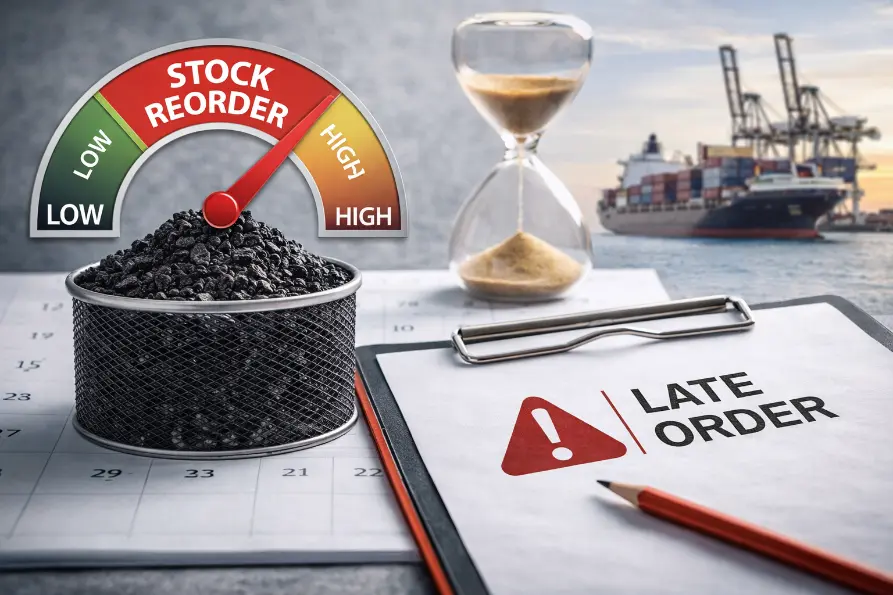
In activated carbon procurement, many buyers naturally focus on inventory efficiency. It may seem reasonable to wait until stock runs low before placing the next order. However, in practice, this approach often creates unnecessary supply risk.
Activated carbon delivery is not determined by production time alone. Reorder timing can also be affected by raw material availability, production scheduling, packaging preparation, inspection, shipping arrangements, and transit time. When buyers wait too long, even a routine purchase can become a time-sensitive supply problem.
For applications linked to continuous operation, scheduled media replacement, project installation, or emissions control systems, delayed replenishment may create costs that go far beyond the material itself.
Why Low Inventory Does Not Always Mean the Right Time to Reorder
In theory, reordering at low stock levels can reduce inventory pressure. In reality, this method only works well when supply conditions are stable and delivery timing is highly predictable. In the activated carbon industry, this is not always the case.
Lead times may change because of raw material fluctuations, production queue pressure, export preparation, or shipping uncertainty. A buyer may assume that a reorder can be arranged quickly based on previous experience, only to find that current conditions are different from the last purchase cycle.
Once stock is already tight, the buyer has less room to absorb delay. At that point, even a modest extension in lead time can affect operations, project milestones, or replacement schedules.
What Buyers Often Underestimate
One common misunderstanding is treating lead time as if it only refers to factory production days. In reality, activated carbon supply may involve several stages before the cargo is ready to use:
- raw material preparation or allocation
- production scheduling
- inspection and packing
- label or document confirmation
- shipment arrangement
- transit and receiving time
For international orders, the full supply cycle may be significantly longer than the manufacturing stage alone. This is why buyers who reorder only when stock is already low often face more pressure than expected.
| Supply Stage | What It May Affect | Possible Buyer Impact |
|---|---|---|
| Raw material availability | Production start timing | Longer-than-expected lead time |
| Production scheduling | Order queue and completion date | Delayed replenishment |
| Packing and inspection | Shipment readiness | Late dispatch |
| Document and label confirmation | Export execution | Extra delay before shipment |
| Transit and receiving | Actual usable arrival date | Operational or project pressure |
What Can Happen When Reordering Starts Too Late
When buyers delay too long, the risk is not limited to waiting a few extra days. The consequences may include:
- higher prices if supply conditions have changed
- less flexibility in specifications, packaging, or shipment options
- pressure on project installation or startup schedules
- disruption to routine replacement cycles
- emergency freight or rushed coordination costs
In other words, what appears to be a purchasing decision can quickly become an operational risk.
What Activated Carbon Buyers Should Do Instead
Rather than waiting until stock is nearly exhausted, buyers should plan reorders based on total supply cycle visibility. A more practical approach may include:
- reviewing future demand earlier for critical applications
- building reasonable reorder timing around the full delivery cycle, not only production days
- keeping modest safety stock for important or hard-to-replace grades
- confirming specifications, packaging, and documentation requirements early
- communicating expected project timing with suppliers in advance
This does not mean carrying excessive inventory. It means reducing avoidable risk by giving the supply chain enough time to perform normally.
Supply Timing Is Part of Procurement Quality
In activated carbon purchasing, good procurement is not only about selecting the right grade or negotiating the right price. It is also about making sure the product arrives when it is actually needed.
At HANYAN, we believe reorder planning should reflect real supply conditions, not only ideal assumptions. Earlier communication, clearer forecasting, and more practical timing can help buyers reduce disruption risk and maintain smoother project or operational continuity.
For many activated carbon users, the most effective way to reduce supply risk is not waiting until stock runs low, but planning early enough to keep delivery aligned with actual demand.
Artical Keywords: activated carbon procurement, activated carbon reorder timing, activated carbon supply risk, activated carbon lead time, activated carbon inventory planning, activated carbon buyers, industrial activated carbon supply, activated carbon project planning